Being chased by an enemy almost impossible to defeat, relying on hiding or running away as the only chance of surviving, is one of the most extreme feelings in survival-horror games. And if famous pursuers such as Nemesis or Mr. X from early Resident Evil games, or Pyramid Head from Silent Hill 2, are the most iconic examples, other games such as Clock Tower made escaping an immortal stalker the core element of their gameplay (and you can read more here: https://surrealandcreepy.wordpress.com/2021/04/10/best-indie-games-similar-to-clock-tower/). However, pure horror games are not the only example where immortal stalkers are present. And sometimes, you can even experience this anxiety in very unexpected genres.
It is the case of turn-based JRPG, a genre usually associated with slow and static games, which instead surprisingly show several examples of immortal pursuers. As expected, several of these creatures come from Atlus games, the developer of the most known horror-themed JRPGs such as Persona and Shin Megami Tensei. On the other side, it is also true that some similar enemies can also be found in less horror-themed JRPGs such as Final Fantasy. Because I think everybody remembers the robot spider from the beginning of FF8. Moreover, this is especially true for more recent horror JRPGs, especially Idea Factory games, and even more fitting for dungeon-crawlers. Probably because of the mazes to explore, or the first-person view, dungeon-crawlers have a huge selection of immortal stalkers, chasing you till an unexpected dead end. And if instant death once trapped is not that different from any survival-horror games, being stuck in an almost impossible-to-win turn-based battle has a completely different taste. And if you find difficult to imagine that, try to think about the pressure of selecting the best move hoping to survive, while the creature annihilates at each turn a different character, or about attempting to escape the battle but failing each time. Moreover, random battles and turns create a denser atmosphere, because you don’t know how many different attacks the creature could do, or when it could appear. Another very interesting concept is that, while in pure horror games there is always a scheduled encounter to kill the immortal stalkers, in JRPGs this could be instead level-based. So maybe 50 levels later, when you are strong enough, you can come back to the stalker that was terrifying you early on to finally kill it.
So what will be on this list? I selected examples of immortal stalkers from different JRPGs, especially if horror-themed, and all with turn-based battles. If not, there would not be much different from pure horror games. The selected creatures should be also almost impossible to defeat, especially when met for the first time, and able to quickly annihilate the party. They should also be active stalkers, or appearing only when connected to rare or unwanted events or mechanics, in fact acting as a negative reward.
Mary Skelter – The Nightmares
Mary Skekter is a trilogy of dark dungeon-crawlers where everything is horror-themed. Not only the games are set inside a colossal living being but also blood is a central element in the gameplay (more info here: Mary Skelter Nightmares: When the dungeon is a colossal living creature with its own needs). But what truly shines as pure horror gameplay are the Nightmares, the immortal stalkers at the core of the experience. Every dungeon has its Nightmare patrolling around, disturbing creatures that are, at the beginning, impossible to kill. They will randomly appear when the player explores the dungeon, accompanied by creepy sounds and a white aura. If they spot the party, the only chance of surviving is to run away as far as possible till the chase is over. The worst thing? The map will be disabled during the chase, so you can easily finish trapped in a dead end. In battle, each Nightmare has an external shell that can be destroyed to briefly stun them, facilitating the escape. However, if random battles happen during the chase, the nightmare will join the fight, creating a very challenging situation. A Nightmare can only be truly defeated after losing the immortality, which will happen by destroying a core at the end of its dungeon. Moreover, the Nightmares are also seriously creepy and disturbing in appearance, linked to the theme of each dungeon and the background of the main heroine there, thus incorporating twisted fairytale elements in their grotesque design. If you are curious about more details, I also wrote a long analysis about the Nightmares, which you can check here: The Nightmares of Mary Skelter: fairytale characters reborn as twisted immortal stalkers.


Undernauts Labyrinth of Yomi – Luci
Undernauts is another dungeon-crawler JRPG, set in 1979 Tokyo where a mysterious structure appeared in the middle of the city. Full of dangers but also resources, soon mining companies start to explore this huge dungeon to unveil its secrets. Developed by Experience Inc, Undernauts is somehow connected to their main series Stranger of the Sword City. However, Undernauts is much more horror, violent, and disturbing than their other RPGs. Let’s just say that the first scene inside the game sees you as the only survivor of your mining expedition, which was was devoured by a kid with a giant leech-like arm. And you survived, only because the child was too full to eat you. While wandering around the dungeons, you will soon meet again that “sweet” cannibal child that spared you. Her name is Luci, an immortal child with a giant leech-like arm, which follows the orders of a mysterious man from a radio around her neck. While exploring the dungeons, you could randomly hear a radio massage of the mysterious man sending the girl to devour the party. After the message, whichever random or stationary battle in the dungeon, will be instead against Luci. So the only way to surely avoid this fight is to quickly run back to the main camp before a battle starts… and this is pretty stressful while exploring. During the fight, the little girls seems so weak and yet so disturbing. But she has the bad habit of attacking the rear row, usually quickly killing your magician or healer, thus making your life pretty miserable even if you succeed in repelling her. Yes, I didn’t use the word “killing” because Luci is immortal and, after behind defeated, she will just stand up and run away, after saying some very sad lines about failure and loneliness. But she will surely come back another time, trying to devour you. Moreover, Luci will also appear in some mandatory boss battles, together with other minions and the ability of massively healing, making such fights even more difficult. Without doubts, Luci is one of the most scary and disturbing stalkers on this list.

Persona – The Reapers
Persona started as a spin-off of Shin Megami Tensei, and now is more famous than the original series. Mixing real life and dark supernatural events, since Persona 3, the saga allows the exploration of huge dungeons while investing in your daily life. And also starting with Persona 3, the Reaper appeared to torment the main party. Especially in Persona 3, the Reaper is a pure horror stalker, integrated since the beginning of the game into the mechanics. If you explore for too long in a dungeon, depending on its size, the Reaper could appear on the floor to hunt you down. Since characters with levels below 70 have practically zero chances of defeating it, finding the exit as fast as possible is the only way to avoid death. Meeting the Reaper means starting an impossible battle, where the party will be annihilated in a couple of turns. The good side is that an end-game party can instead defeat the Reaper, unlocking very rare rewards. The Reaper is also present in Persona 4, but this time it acts only as a secret super boss, which can be faced only during a second playthrough after opening a mysterious chest. In Persona 5 the Reaper is back to stalk the party inside the dungeons, very similarly to Persona 3. When the Reaper appears, accompanied by the sound of rattling chains, the other party members will try to warn you about its danger, and how running away is the only option. Again, the battle is almost impossible to win due to the Reaper’s high defence and instant killing spells.

Etrian Odyssey – FOEs
A JRPG saga that truly integrated challenging battles against almost impossible foes is the dungeon-crawler Etrian Odyssey, published by Atlus. In almost every game of the saga, strong enemies called by the acronym FOE wander around the dungeons. They are always challenging enemies, usually very difficult to beat during the first visit, so it is always a recommended strategy to avoid these fights. However, Etrian Odyssey also integrated very interesting and variegated behaviours for the FOEs. In general, red FOEs work as relentless stalkers, charging at the player if in their sight. For example, the Freed Savage (Etrian Odyssey III) is a grotesque being caged behind gates but, once freed, the creature will quickly run toward the player to attack it. Other similar examples involved FOEs acting in pairs. For example, the Cruel Slayer (Etrian Odyssey IV) is a relentless robot hound almost impossible to outrun, but it will only start to track the players if they are spotted before by a wandering sentinel called the Cold Watchman. However, FOEs also exhibit more complex, hunting, and disturbing behaviours, creating challenging predators to avoid. A deadly example is the Vampire Tree (Etrian Odyssey III), an invisible FOE with a very horror-predatory behaviour. The tough monster will get visible only if close to you while you are in battle, slowly advancing at each turn of the fight. If you are too slow in the random fight, the FOE will join the battle. And having a tough boss with high defence, and a lethal poison that will both damage the characters and cure the monster, is not an easy challenge. Talking about erratic patterns, the disturbing Taurus Demon (Etrian Odyssey V) doesn’t directly charge the player, but once they line up with the monster, the FOE will start to mirror their movements, even if they are very far away. And since the creature is a deadly physical attacker, avoiding it is a necessity. Another deadly and peculiar FOE from Etrian Odyssey V is the Mounting Horror. The monster doesn’t move from its position, but will instead generate clones as strong as it to hunt the player, and the only way to survive is to find and kill the real monster. But the top spot for the scariest and most peculiar FOE from Etrian Odyssey goes to the Death Wall (Etrian Odyssey 2 Untold). Imagine being trapped in a twisted labyrinth typical of dungeon-crawler games, trying to find your way out. At some point, maybe you start to see that a wall was never there. What is happening? This is simply Death Wall, a FOE that mimics a normal dungeon wall… which will move only if you are not watching it. And once you are trapped in a dead-end hallway, you are forced to face it. And this is a battle where you cannot escape, and the Death Wall will literally try to crush all the party with strong physical AOE attacks.

The Lost Child – Nyarlathotep
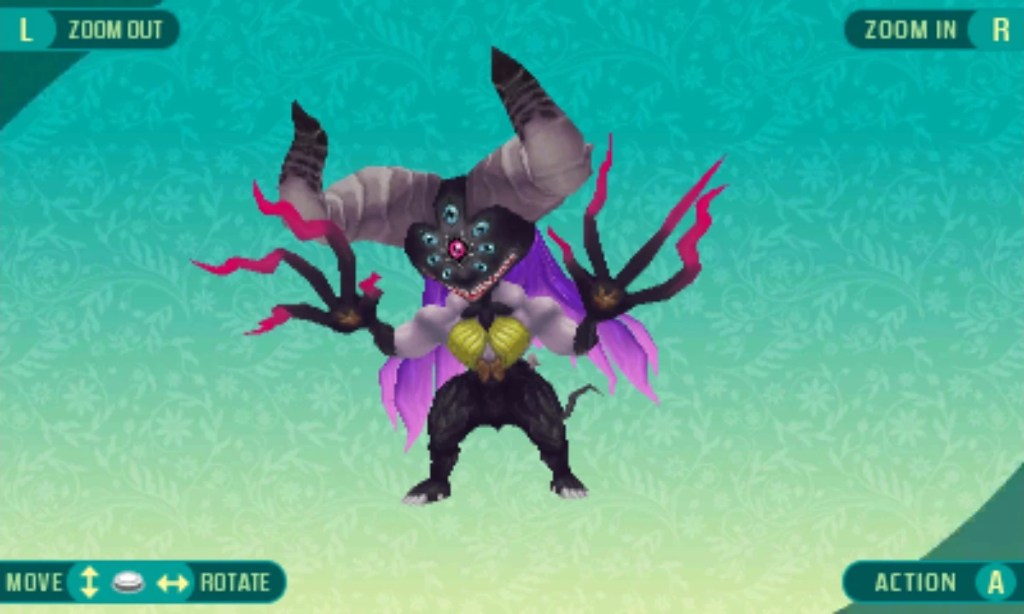
Another dungeon-crawler to add to the many on the list, Lost Child is a spin-off of El Shaddai, an action game involving Catholic mythology and angelic wars. Sharing many similarities with Shin Megami Tensei, in The Lost Child, the main character can trap demons and fallen angels to fight in the party. And the design of the enemies is very original and interesting, as you can see here for some demons: The most unusual Demons from the Japanese dungeon-crawler The Lost Child. However, angels and demons are not the only enemies, since the main bosses are Lovecraftian creatures, including Cthulhu. And Nyarlathotep from the bonus dungeon R’lyeh Road is an immortal stalker that deserves to be in this article. R’lyeh Road is a gigantic bonus dungeon of 100 floors, which can be faced at any point during the game. Each floor has only one exit, and a switch to open it. And the big twist is the presence of Nyarlathotep, which will manifest on every floor once the door is open. Nyarlathotep does not physically face the party but, as a sort of alien parasite, will take control of normal enemies, appearing behind them like a sort of puppeteer, enhancing them to a boss-level threat. The other unique feature is that Nyarlathotep will physically appear on the map, charging toward the player, one step at a time. By planning your moves and using big rooms to your advantage, it is fact possible to avoid Nyarlathotep and escape to the next floor. So how it is possible to truly defeat Nyarlathotep? You can discover the answer only on the 100th floor of R’lyeh Road, making Nyarlathotep one of the most relentless stalkers on the list.

Mother 3 – Ultimate Chimera
Earthbound saga is a cult game not only in Japan, but also worldwide, one of the weirdest RPG ever developed that influenced recent RPGs such as Undertale or Omori. Between funny and disturbing moments, the party will face different creatures, each requiring very peculiar strategies to be defeated. And in Mother 3, there is also an immortal stalker: the Ultimate Chimera. This creature, created inside a lab, looks like a fluffy pink monster with a pair of small wings. But behind this innocent-looking monster lies a deadly enemy. Once it sets free, the monster will roam the lab attacking NPCs and chasing the player. The terrible surprise is that, instead of starting a normal battle, meeting the Chimera means an instant Game Over. There is no hope in fighting the creature, so running away is the only alternative. Luckily, the ultimate Chimera can be deactivated by a button on its back… but only temporary since the party will meet the monster again during the game.

Death end re;Quest 2 – Dark Shadow
The sequel of one of the most horror and disturbing JRPG from recent years is even more insane and terrifying. Hopping between a cursed virtual reality and a town hiding a cult, Death end re;Quest 2 shows a set of really grotesque enemies (that you can check here: The most creepy and disturbing enemies and bosses of Death end re;Quest 2). But random enemies are not the only threat, since another entity could appear anywhere to hunt the party: the Dark Shadow. This cryptic creature appears together with some distortions in any point inside a dungeon. The towering shadow creature advances slowly toward the player, but a mere wrong turn inside a dead-end hallway… and it is Game Over. Because as with the Ultimate Chimera in Mother 3, simply touching the Dark Shadow means a sudden death. Moreover, sometimes the game will position the Dark Shadow in impossible points, where gimmicks like finding hidden suspended paths are the the only way to avoid the creature.

Shadow Hearts – Fox Face
Shadow Hearts is the first (or the second, if we consider Koudelka) entry of a dark saga of JRPGs released for PS2. Mixing European history with demons and eldritch abomination, the game knew how to assemble RPG mechanics with horror elements. And an immortal stalker could not miss this setting. Shadow Hearts involved a very peculiar mechanic around the Malice, a dark and malevolent energy released from death. The more the main character kills enemies in battle, the more Malice is accumulated. Till the breaking point, where the UI becomes red and the Graveyard opens its door. At this point, the Fox Face can appear instead of any random encountered. At first, the creature is not very intimidating, merely a human with a fox mask. However, this adversary represents the protagonist’s fears, and can be challenged only in a 1-on-1 combat, where death is the most possible outcome since the enemy has many dirty moves. The player can lower Malice and avoid Fox Face by going to the Graveyard, to then speak to mysterious floating masks demons and participate in their fighting arena. This is a perfect example of a terrifying stalker very well integrated into the game, so deadly and scary because the main character must face it alone.

Fear & Hunger – Crow Mauler and Greater Blight
Fear & Hunger is probably the darkest RPG ever made, set in a world so grim and sick that will make you often chill. Featuring a combat based on mutilations, where several negative effects are permanent, including death, and lacking any experience coming from combat, avoiding enemies is the standard in this game (and for more you can check the different articles I wrote here: https://darkrpgs.home.blog/category/videogames/fear-hunger/). But some enemies are even more specifically design to act as terrifying Stalkers. The most fitting example is the Greater Blight, a gigantic creature roaming the empty wasteland of the Void, a secret end-game area. While wandering around, sometime a message saying that something is following you will appear. Ignore the message, and soon enough more intimidating ones will appear. If you find a hole in the ground on time, you can hide there till the creature loses your scent. Otherwise, be ready for a tough battle. The Greater Blight looks like a gigantic T-rex missing the eyes, a deadly foe that can slaughter the entire party in a couple of turns. However, a strong and lucky party can still defeat the creature, which will only escape to prepare for another chase. And the player will gain nothing from this deadly battles, except probably for dead characters and mortal wounds. Another infamous enemy is the Crow Mauler, probably the most hated boss in the entire game. In the beginning, Fear & Hunger has only one save point, an old and forgotten bed inside a jail. However, saving in the game is also dangerous, since you have a 50% chances of facing the Crow Mauler. And an underprepared party will also surely die there, because the tough creature has even one-shot attacks. But if you want to freely save the game, soon or later you must defeat this creature. And if this was not enough, the end-game dungeon has trapdoors scattered around. If you fall inside them, you will finish in a basement… chased by a two-headed Crow Mauler, an enemy almost impossible to defeat. Anyway, if you are curious to know more about the Crow Mauler, I wrote an analysis here: When it is impossible to Save: surviving all the mutilations of the Crow Mauler in Fear & Hunger [Boss Battle].


If you want to check the Greater Blight getting your smell, and the battle against this terrible foe, you can check the video on the Surreal and Creepy YouTube channel:
Shin Megami Tensei – Jailer and Dante
Shin Megami Tensei saga doesn’t need introduction, since it is probably the most famous and longevous dark JRPG around. Moreover, the monsters based on mythologies around the world, created by Kazuma Kaneko, are still now an example in monster designing. And surprisingly, some of them also worked as immortal stalkers. An example is the Jailer from Digital Devil Saga (also known as the Buddhist demon Kumbhanda), a deviant creature in charge of a prison. The jail is also a factory where humans are converted into canned food, the Jailer’s favourite. And yes, if you didn’t know, cannibalism is a central theme in Digital Devil Saga (and you can read more about it here: Digital Devil saga: A cannibal JRPG — Surreal and Creepy). During the first battle against the Jailer, you will realise of a drastic anomaly: the boss has an attack able to paralyse everybody with a 100% success rate, quickly ending the battle. Later on, the prison becomes its hunting ground, where the main character should physically escape from the Jailer and its traps, while finding a way to trick it into losing its powers. If the Jailer is a pure horror stalker, another enemy is an even more emblematic hunter in Shin Megami Tensei. Just this time, it is an enemy that you would never expect. “Featuring Dante from the Devil May Cry Series” became quite a meme for SMT 3 Nocturne, and the legendary demon hunter from Capcom’s games truly appears in one of the bonus dungeons. Dante will literally stalk the player while exploring a complex maze, shooting them if they are far but still in his range, or starting a deadly battle when reaching them. In the last case, Dante will immediately kill the weaker demon in the party with his sword. And if the main character is the lowest-level one… well, time for an instant Game Over.

Persona Q – FOEs
Persona Q is a spin of the main series released for 3DS, with a gameplay more similar to Etrian Odyssey than the regular Persona. The similarities are so many that, even in this case, while exploring the dungeons, you can meet deadly FOEs. As well as for Etrian Odyssey, FOEs have different behaviours, and, in general, it is often recommended to avoid them. Moreover, due to the darkest nature of Persona setting, the FOEs are even more disturbing. For example, the Beast of Lust is a sort of small Cherub seated on top of a bondage horse, creating a very disturbing enemy that follows the player if they are directly watching the creature. So no eye contact, no pain. In the next dungeon, the Evil Spirit Club, the party must face creepy clusters of dolls, the Lovely Dolls, which share some similarity with Junji Ito’s Tomie. They are stationary, but tends to surprisingly teleport toward the player causing a jump-scare. Luckily, the light can repel those dolls granting safe passages. And if the Loving Dolls are not enough, the ancient version, the Old Doll, will actively chase the party and can even block some doors to create smaller hunting grounds. Other FOEs, such as the Festival Dudes, act as super tough side battles. They are a group of 4 monstrous and coloured muscled guys bringing around a shrine, which move in a fixed pattern around the dungeon. However, even if they are extremely strong, they can be defeated by selecting specific characters for a very unusual party. To conclude, the Reaper from previous Persona games is also there to hunt and terrify the party in the last dungeons.

Trench Tale – The Horse
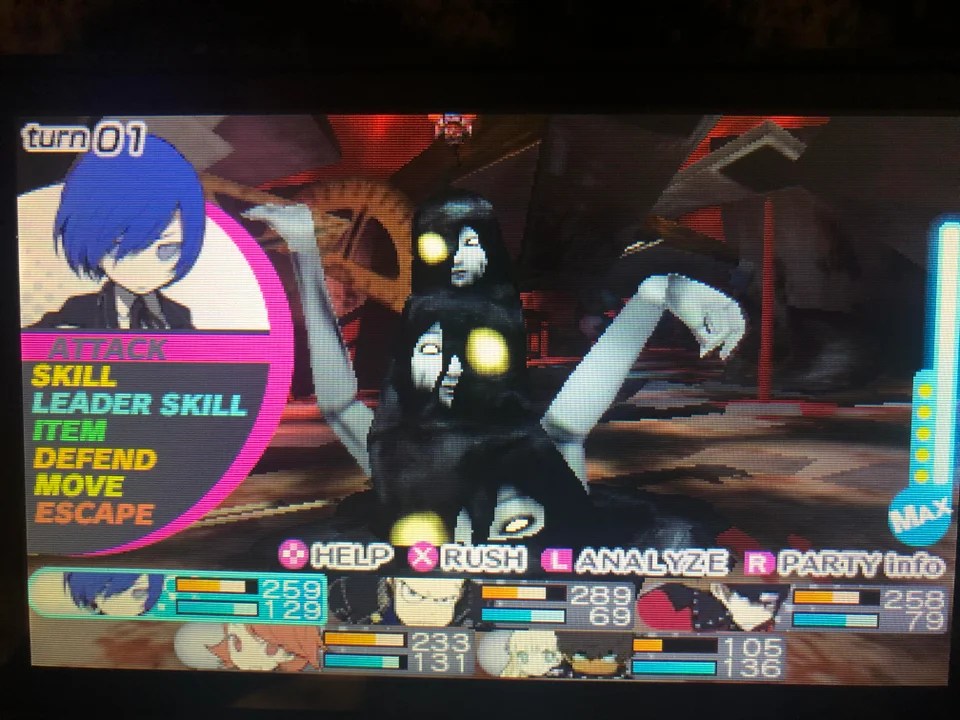
Trench Tale is a game heavily inspired by Fear & Hunger, with a similar limb-targeting-based combat system and a dense horror atmosphere. The game is set in an alternate WW1, with even more horror elements and puppet enemies roaming gas-filled trenches. While the main game features different classes, including a sniper and a humanoid rat, the expansion follows the story of a specific character trying to escape the trenches. Interestingly, the expansion features a more open-world scenario, offering greater freedom in how to proceed. However, keep in mind that dangerous creatures are hidden in this world, including the Horse. This disturbing creature is a yellow horse carcass, with a skull head and a muscular, undead body. The lower half of the body terminates in a mass of grotesque tentacles, acting as the “strings” of this undead horror. When you first meet the Horse, accompanied by rope sounds, the grinning and yellow face of the Horse appears on the screen. And the game will tell you to run. Running away through a claustrophobic bunker, while avoiding mountains of deadly metal wire and being outrun by the deadly Horse, is definitively a difficult task. Because if the Horse reaches you, it starts a battle almost impossible to win. The Horse has several attacks, including the Bite, which inflicts an insane amount of damage. From this point on, the Horse will chase the player in other bunkers, creating a dense and terrifying atmosphere. Moreover, the Horse can also appear in unscripted events in the outside world, starting deadly chases through the maze of trenches. And quickly finding a door to end the chase, while avoiding the Horse and other monsters, is the only way to survive.

You can also see the Horse in action here:


 Dark RPGs