Felvidek is a surprising RPG set in a dark fantasy version of 15th-century Slovakia, with great art-style, nice combat, and a good balance of comedy and horror. The animations are especially great, both during combats, with detailed pixel art attacks, and cutscenes, including trippy and bizarre scenes. At the core, Felvidek is a JRPG with turn-based combats, where the characters must explore a small but rich open world. Moreover, Felvidek is full of secrets, hidden paths, and easy-to-miss secondary quests, everything to expand the characterization of the game even more.
In this grim historical world, you must be ready to face Hussites, Ottomans, and other human enemies in challenging turn-based combats. However, things will get a dark fantasy twist once the Cult is revealed, the main antagonist of the game. Every enemy has a specific color palette here. For example, the Hussites tend to be yellow while the Ottomans green. And purple is the color of the Cult and its bizarre members. In the beginning, the enemies are regular robe-wearing cultists, or more armed soldiers, normal humans associated with the Cult. Then, grotesque maws and eyeballs start to appear on the humanoid designs, creating a new breed of disturbing cultists. Later on, true abominations will join the Cult’s ranks.
A nightmarish being visiting the protagonist
Everything in Felvidek irradiates personality, from the art-style to the animations and unconventional characters. In fact, the protagonist is a drunk soldier always grinning and obsessed with reconquering his wife that cheated on him. Felvidek takes huge inspiration from Slovakia, from traditions to jokes and history. Even the language is heavily influenced by the Slovak.
In the following interview, I had the opportunity to interact with Jozef Pavelka, one of Felvidek’s creators with Vlado Ganaj. Together with Jozef, we will analyse the work behind Felvideks, its secret, and a possible future DLC.
Q1: Thank you, Jozef, for the opportunity to interact with you. Felvidek is one of the most interesting RPGs released this year. How did the development of the game start?
A1: The project originally started at SUTNARKA (faculty of design and art) as a visual exercise with the goal of creating a design for the exterior, interior, and a character that could traverse them. It snowballed from there.
Q2: What were your references and inspirations while developing Felvidek?
A2: It’s important to note inspirations differ for me and Vlado Ganaj, the writer of Felvidek, although there is a lot of overlap. My greatest inspiration was Teodor Schnitzer, Slovak graphic print artist. As for the games, Gothic, original Fallout and Hylics come to mind. Vlado drew a lot of inspiration from Slovak literature and movies.
Q3: How challenging was it to combine historical events and characters with more occult and dark-fantasy themes?
A3: Felvidek is not historically accurate educational material, even though a lot of research was made into the material culture and the events surrounding the story of Felvidek. We use the medieval setting more for atmosphere and visuals. Occult themes lend themselves for such environment.
A fortified cathedral… inside the belly of a monster
Q4: Felvidek has a very peculiar and interesting art-style, including animation, cutscenes, and the specific color palette for particular characters (for example, purple is for the Cultists). How did you define this specific style and color scheme?
A4: The style is a result of a dance on the intersection of digital and traditional graphics. I love exploring new ways of incorporating traditional printing techniques into digital art and vice versa. This approach to digital art was at the core of my academic studies.
Q5: Felvidek is a game completely rooted in Slovakia history and traditions. Which is your favorite legend or myth from Slovakia incorporated into the game?
A5: I love that we incorporated Hussites into the story. Most people don’t know that they were on our land in the 15th century, let alone the impact they had. Also a lot of Slovak memes, politicians and some jokes are referenced, in one way or another.
Even a well could hide a mystery
Q6: What instead about a myth or legend from Slovakia that you didn’t include inside the game? Thinking about it now, how would you include it in Felvidek?
A6: I won’t tell, for I would spoil a bit of our planned DLC.
Q7: Sharp knives, cheating, and a smile always on the face: the love story behind Felvidek is definitively a peculiar one. Could you comment on how this love story became a central element of the plot or helped to define the characters?
A7: Vlado needed a personal story for the characters to create an emotional reason for the plot to be driven, as opposed to the characters just investigating some unholy plot.
Is the main character finally kissing his wife?
Q8: Felvidek is full of secrets, sub-quests, and hidden elements. Which is the most hidden secret that you are proud of?
A8: I love the original interaction with Pištík you get when you approach him after you were robbed by Ida.
Q9: Eyeballs, maws coming out of the stomach, and fleshy demons: which is your favorite enemy?
A9: Has to be Numbnut. I mean, what a bloke.
Grotesque monsters slowly join the human enemies
Q10: We are very curious to know which are your future plans. Is Felvidek 2 a possibility or are you working on a different project?
A10: Right now I am working at Warhorse, but we are currently also developing a DLC for Felvidek with Vlado. I have plans on what to do after, but those are projects that will take up years.
Final Remarks:
I would like to thank Jozef for the nice opportunity and really interesting answers. It was very nice to learn more about the work behind Felvidek, and I am really curious about the future DLC. While waiting for the DLC, you can find Felvidek HERE.
Blue Reflection is one of the rarest games of the last generation, and also a very peculiar JRPG. At first glance, the title looks like a generic school-setting JRPG focused on fan-service. And yes, the game has many scenes of the protagonists in “unusual” situations, but there is also far more to that. While it is true that Blue Reflection is entirely set inside the school, with just some quick missions inside a parallel dimension, the game also shows pretty unique quirks.
The main protagonists are modern magical girls, using their powers to face some really disturbing enemies: the Sephirot. While waiting for the Sephirot’s arrival, the party must explore dungeons inside the mind of schoolgirls heavily disturbed by a feeling, till going insane. And if you think now we are getting to darker territories, let me just focus on how Blue Reflection has big vibes from Puella Magica Madoka and Evangelion.
The references to Madoka are pretty obvious: magical girls fighting disturbing beings, with the truth getting each time creepier. The Sephirot are instead the connection with Evangelion, and the main reason behind this article. Mysterious and powerful beings, there are only 4 Sephirot, and each of them is attracted to the school. The heroines need only to wait enough time till a Sephira shows up. And then, a dramatic battle begins. Exactly like for the Angels of Evangelion.
The Sephirot have a dark and intriguing design, which really stands out from the general “school-life” setting of the game. Moreover, every battle against these beings is extremely choreographic, a long collections of insane action and gorgeous attacks. Seriously, the game completely changes during these battles (which you can see in a video at the end of this article). Each Sephira will attack the school twice, and only in the second and most difficult battle they can finally be destroyed.
So without further introduction, let’s have a look at the 4 Sephirot.
Yesod
The first Sephira is probably the most grotesque and disturbing, a colossal mutant composed of multiple bodies fused together. The lower body is the largest creature, a four-legged mutant with a big and grotesque face. Nested inside the lower body lies another face, the smaller body, surrounded by many arms frenetically moving around. The main body towers above, a muscular and thin mutant with long tentacles instead of fingers.
Yesod appears shooting deadly beams toward the school. The creature will get closer and closer during the battle. From afar, Yesod will target the party with strong beams and explosions. The multiple bodies of the creature are also potential targets and, once all the different heads are destroyed, the main body will get weaker. However, there is few time to celebrate, because Yesod will quickly reanimate them. When getting closer, Yesod can attack by creating shockwaves by hitting the ground, or using a dangerous bone blade coming out of its body.
Cochma
This Sephira looks like a cross between a Gothic cathedral and a tank. Cochma walks around like a tank, a bizarre vehicle harbinger of destruction. Its secondary cannons look like pinnacles of a modern church, thin and pointy, but not less destructive. The main body seems more like a creepy skeleton, with a huge round mouth, which of course works as the main cannon.
Cochma uses its dozens of cannons to attack the party. Some cannons shoot direct projectiles, while others throw grenades. Moreover, hundreds of machine-guns are hidden inside holes in its body, and they can shoot all-at-once for a storm of bullets. The main cannon is of course the most dangerous attack, a massive weapon able to cause insane damage. Cochma’s cannons are divided into two sets: Eas and Wes (East and West?). By destroying them, the party can temporarily disable the cannons.
Tephereth
If you were looking for a closer connection with the insane geometries of some Angels in Evangelion, such as Ramiel or Arael, Tephereth is the closest link. Appearing as what could be described as a flying jewel, the Sephira is a golden creature emitting energy. When it appears, the skies become of unnatural colours.
The creature is a strong opponent, with different body parts able to boost attack and defence. Tephereth mainly attacks by throwing storms of darts and energy bullets, so many that will cover the battlefield with explosions. Moreover, its body can reassemble, like a mechanical being. This includes morphing the main body into a sort of chainsaw, to then crash into the battlefield.
Netzach
The last of the Sephirot has a rather simple design. Netzach is a sort of mix between a knight in heavy armour and a Gundam. The crystallised armour protects the creature, while a spear and a shield work both as weapons and extra protection. The Sephira has some sort of wings, working like a propeller and allowing it to fly around.
Without surprise, Netzach is the strongest Sephirot. Its weapons are both targets, called Drago, probably in honour to dragon-slayer knights. The shield can heavily buff its defence, while the spear can throw many attacks, including an energy beam. The Gundam-like appearance of the boss is also reflected in some attacks, including throwing arrays of missiles from the shoulders. The shield also works as a weapon, transforming into a circular saw. However, the most dangerous attack is when the spear becomes crystallised. The difficulty of this boss battle lies also in the ability of Netzach to inflict many negative statuses, including a deadly poison that will quickly bring a character to death.
In the following video on Surreal and Creepy Games, check all the battles against the Sephirot.
LISA is definitively one of the best indie JRPGs ever made, pushing the RPGmaker engine to an impossible edge. It doesn’t come as a surprise that other games took huge inspiration from this masterpiece. Gutter the Cursed is one of these games, set in a brutal post-apocalyptic town where brutality and comedy clash and merge. The combat system is also heavily inspired by Lisa, with combinations of attacks associated with more powerful skills. However, the similarities end here, since Gutter is a hidden jewel of open world and sandbox mechanics. While exploring the city, the player can attack everybody, from merchants to the bosses of the different factions. The game also features many secrets, endings, and two DLCs expanding the world with complex side stories: the Rejected, where the player is a failed clone, and the Perished, where the player is a ghost roaming the underworld.
A deep gameplay element of Gutter comes at the very beginning of the game: the backgrounds during the character creation. The player can decide between different origin stories, each coming with perks and bonuses. Some backgrounds will slightly change the game, making it easier or more difficult, providing unique weapons and skills. Now let’s check some of these examples.
Raised by Snake Charmers makes you fast and resistant to poison, while also providing a pet snake for your adventures: a weapon with 95% chance of poisoning the enemy. Feral Child increases the resistance against diseases and provides the perk Cannibalism, which unlocks special moves to bite the enemies, healing or inflicting bleed. Moreover, backgrounds slightly change when creating a male or female character. For example, a male character can become an Ugly Outcast, which makes you weaker while increasing the evasion rate. Instead, the female equivalent is a gorgeous creature, specifically the Beautiful Harlot, which is similar but also provides the perk Beauty. Other backgrounds only available for female characters are Tomboy and Circus Performer, which unlocks the special skill Throwing Knives.
Other backgrounds can instead drastically change the game, creating a completely different playthrough and affecting party characters. In such a post-apocalyptic wasteland, the main character can of course also be a sick psychopath. The Disturbed Mind background has a huge effect during the game since it affects your relationship with the other recruitable characters. Some characters will refuse to join your party, feeling the evilness emerging from your body. On the other end, another character will become recruitable only when the Disturbed Mind is available. When reaching the Theatre in the main town, the spectacle inside is terrifying. Mutilated bodies all around, but still alive, willingly allowing the dominatrix hiding in this place to hurt them: Malice. In a normal playthrough, this will start a complex battle against the insane woman. However, with Disturbed Mind, Malice will be mesmerised by your “evil aura,” joining the party. And of course, she is an extremely powerful character. It is very interesting that choosing a specific background, among more than 10 others, unlocks a new recruitable character.
While being evil or with a troubled but cool past is not new, the Special Mind background is definitively unexpected. In this case, this origin doesn’t allow any positive perk but will drastically change almost every dialogue inside the game. The main character has huge social impairments, altering the choices into incomprehensible mumblings. As the Abomination background for Gutter the Rejected (below), Special Mind is one of those backgrounds that offers a completely different experience, thus reserved for specific runs after finishing the main game. Every dialogue and choice is in fact far more difficult to understand, and it is difficult to comprehend where “poking your nose” could lead in the conversation.
In Gutter the Rejected, the first free DLC, the backgrounds will go in an even crazier direction. This time, the main character is a cloned experiment that wakes up inside a lab. Foreigner DNA was combined with a human host, creating a specific abomination. For example, having Alligator or Squid DNA in your body unlocks special moves. The main character will gain useful skills to use during the battles, respectively 50% resistance to every damage and tentacles to trick the opponents into falling to the ground.
The Werewolf is another background available in the free DLC The Rejected. Among the many monsters to choose from, the Werewolf is one of the most interesting mechanic-wise. While the main character is still a normal human, at least in appearance, the transformation is intrinsic to the gameplay. During the battle, the character accumulates Rage to perform special moves that, when reaching the maximum, will allow the metamorphosis into a werewolf by using War Form. While the form lasts, the character will gain an insane strength, allowing deadly attacks and combos.
If playing a hybrid clone borne from an experiment that went wrong is already an interesting choice, the Abomination is definitively the most intriguing background of Gutter the Rejected. The Abomination is a grotesque creature borne from pure darkness. The main character will receive incredible powers, including strength, HPs, and special attacks. However, almost every character will be terrified of the Abomination. By playing this background, the player will lose access to many secondary quests, since the secondary characters will be terrified by the Abomination. Some of them will simply refuse to talk, while others will attack the player at the first dialogue. Moreover, the human party member refuses to join the Abomination. This background drastically changes the game, creating a really unique evil playthrough… maybe for a “kill them all” run.
The last DLC, Gutter the Perished, brings the post-apocalyptic RPG into the afterlife. In this DLC, the main character is already a ghost, who now roams the afterlife fighting ancient phantoms while discovering the reason behind their murder. While the underworld can be explored as the main game, roaming the land of the living plays as small puzzles, where you can use ghastly powers or possess people to unlock the next steps of the case. And of course, spirits from different parts of the world are available as background. The ghosts have different skills during the fight, and can solve the puzzles with their specific powers. For example, a Banshee can obsess people with creepy talks, sending them crazy, while a Jinn can enter inside the dreams of sleeping characters. Other ghosts can instead mess with the environment. A Revenant can hijack electric devices… including robots, which can become killing machines. The Yokai are the most interesting ghosts, able to appear in the human world with different forms, from a tiny messy rat to a fearful werewolf.
Gutter the Rejected was released few weeks ago. Meanwhile, I hope for another future DLC to see which other crazy backgrounds will be available.
The Slit-mouthed Woman (or Kuchisake-onna) is probably one of the most famous Japanese urban legends. The creature is pretty old and part of the variegated supernatural Japan background as much as any other Yokai or Onryo. The most official source for the Slit-mouthed woman is a newspaper article in Gifu prefecture dated back in 1979. Then, more articles about the creature started to spread, almost causing panic across Japan. Other references connect the Slit-mouthed Woman with the victims of horrible crimes back in feudal Japan, making her a proper Yokai.
Regardless of her origin, the story and the appearance are pretty much the same. The Woman looks normal, the only peculiar element is a mask covering her mouth, often a surgical one. In Japan, face masks were always very common, long before the advent of COVID-19. However, there was probably a time back then when it was still not so common to see people around wearing it, thus creating this urban legend. After the mask is removed, the Slit-mouthed Woman will show her terrifying face, with a big and carved mouth, often depicted as full of pointed teeth. The creature always carries with her a blade, such as a knife or scissors, which she uses to kill or disfigure her victims. When encountering a victim, the Slit-mouthed Woman will ask if she is pretty. If the victim agrees with her, she will carve the victim’s mouth to create the same disfigured smile. Instead, if the victim answers negatively, the Slit-mouthed Woman will simply slice the victim’s throat. Possible ways to escape from this terrible fate include giving a more generic and neutral answer. The Slit-mouthed Woman can also be driven away by showing her a distraction, such as throwing candies or money on the ground.
The Slit-mouthed Woman appears as the first case in the horror-adventure World of Horror. The game has an interesting 1-bit art-style and features deadly mysteries to solve and disturbing creatures to defeat (you can have a glimpse of the bestiary here: The most disturbing eldritch creatures from the bestiary of World of Horror). World of Horror takes huge inspiration from Japanese folklore and horror mangaka such as Junji Ito or Kazuo Umezu. It then comes without surprise that creatures from Japanese urban legends are also widely present in this game. In fact, the Slit-mouthed Woman is the first boss encountered during the tutorial. The mystery is set inside a school where brutal murders are happening, caused by a woman wielding a pair of scissors. The Scissor Woman here is more of an eldritch curse, a being materializing from dense smoke to massacre people, to then disappear to curse another place. To stop the Slit-mouthed Woman, it is necessary to find the correct elements of a ritual and to draw the perfect glyphs on the blackboard. By doing this, the player can face a normal version of the Slit-mouthed Woman, a very simple battle in a usually complex game. The Scissor Woman will take shape from black smoke as a tall woman wearing a raincoat and wielding a pair of scissors. The creepy detail? Her head is composed of three different heads, lined up vertically and connected by a continuous twisted and grin smile. However, the interesting detail is that this is only one of the four different versions of this boss.
For example, if the player fails to perform the ritual, a more eldritch version of the Slit-mouthed Woman will manifest. And this will be a tougher battle. The Horror Slit-mouthed Woman is a far more difficult enemy, the true eldritch essence of this monster not weakened by the ritual, with more attack power and HPs. Her face is more twisted and evil, even far less human, with void eyes or even multiple eyeballs in her faces. Defeating this strengthened version will award a special weapon, her Cursed Scissors, the second most powerful weapon in the game but with the downside of having a small probability with every attack of fastening the coming of eldritch gods. Defeating the Horror Scissor Woman also unlocks the Ending B. Both versions of the Scissor Woman can also permanently disfigure the main character by carving her characteristic creepy smile on their face.
The third version of the Scissor Woman is very peculiar to face because it is completely related to another case. This mystery is a long investigation involving mermaids, creatures from the depths, and the mad school janitor. During the final face-off with the janitor, one of the options to survive without fighting the boss is to burn down the school. Yes, a very drastic option that will damage the main character but also opens a new possibility. In fact, if you then have available the Scissor Woman’s case and you play it after burning down the school, the game will remember this event. While exploring the ruins of the school, you will face the Burned Scissor Woman, a modified version of the Horror one with fewer HPs but even higher damage. Her design is similar to the Horror one, but in this case, her skin looks almost melted.
The last version of the Scissor Woman can only be challenged when selecting Timeline B upon creating a custom scenario. Timeline B is a more difficult playthrough, and it will often open to new boss battles in previous cases. Regarding the Scissor Woman, by playing Timeline B you can face the Ghost Scissor Woman. This is by far the most challenging and eldritch design. Losing any human appearance, the Scissor Woman is now only a towering pile of heads, twisted and grotesque, spiraling around in a mix of grin smiles and eyes opening inside the hairs. Every face will be maddening whispering “Am I beautiful?” with different tonalities. This time, the Scissor Woman is not a tangible being but a Spirit. In this case, a proper battle is impossible, and the player should find the correct combination of Bows and Claps to complete the ritual and exorcize the Ghost Scissor Woman. Failing the ritual unlocks Ending D, which implies that the ethereal form of the Scissor Woman can possess and control other people, marked by the creepy smile.
Shattered Heaven is a deck-building RPG set in a grimdark world where God was murdered, and now humanity is paying the price for this sin. Humans live only till 40 years old and cannot reproduce if not by winning a brutal trial. Every 10 years, each tribe sends a Vestal and two Guardians to join this brutal trial, under the suspicious eye of a reborn Divine Child. The lore and the world are truly amazing, well-thought-out, and original in every detail, including the disturbing enemies. In the following article, I will analyze the setting and the creatures inside Naraka, the first dungeon of the game.
Cintamanya is the jewel of Sentia, one of the four tribes, a city made of gems and paintings. Sentians are obsessed with preserving memories and history, for this reason, they build the colossal Chantry. This palace is a special place where each room is dedicated to preserving a memory or an event. However, Cintamanya has a problem: it is built around a gigantic hole called Naraka. The abyss is inhabited by malevolent undead creatures, which are luckily trapped in there. But something else is resting at the bottom of Naraka, something far more malevolent. The Divine Child sent all the Vestals and the Guardians to discover the secret of Naraka, but none of them returned. And it was because of Eris, the most powerful Vestals of Sentia.
Naraka is a deep abyss, with colorful alien flowers scattered around, created from the powerful illusions of Eris’ powers. A gigantic building, the False Cathedral, protected by illusions, is the only human-built structure inside Naraka. The undead creatures are here reborn and morphed into twisted beings mixing flora and fauna. Animal or insect anatomy here mixes with tree elements, such as branches or leaves. Porcelain faces are also another common element inside Naraka, but this could be in fact an alien element since porcelain is often associated with the extinct Gods. The inhabitants of Naraka all have Latin names characterizing them, and the place shows other classic connections, especially since Naraka is also the name of Hindu Hell.
Discover in the following analysis the peculiar creatures inhabiting Naraka, and the story of her creator, Eris the Betrayer.
Clamoris
Clamoris is a truly disturbing enemy. She looks like a human female, a sort of holy vestal dressed in an elaborate vest, an extra pair of arms… and with their face in her hands. In fact, under the hood covering the head lies nothing, a void hole full of shadows where the face should be. The real face in their hand has a void or sorrowful expression, an emblem of Naraka’s atmosphere, a place of death and fake blossom. Moreover, the face is imprisoned inside a bird cage, another symbol of the dramatic situation inside Naraka. This shade of her past self, Clamoris in Latin means noise. Coming from the name, her main form of attack is Deafening Scream. The head will disturbingly scream, with an insane and terrified expression, damaging the entire party.
Sanies
Insect traits are a common feature between some of the creatures inside Naraka, including the bosses. Sanies (meaning something like “pus” or “poison”) is a mantis-like creature that strikes using its blade arms, with a powerful single-target attack called Lacerate. Sanies exhibits a long tail, more similar to a lizard or a dragon than an insect, while the face is a hollow porcelain mask. As previously specified, in the world of Shattered Heaven, porcelain is a connection with the murdered Gods, something that works like a spreading disease, infecting and sending creatures crazy. However, the most peculiar detail of this creature is the three swords in its thorax, a crude reminder that the creatures inside Naraka were once humans killed in battle.
Young Silva
Regardless of the innocent name, Young Silva is a grotesque abomination. The creature’s base is clearly a deer, an animal symbol of forests, but where something got really wrong. While the lower half is “normal,” the creature separates where the neck should be into an unidentifiable and amorphous abomination. A set of fleshy tendons connect the main body to a grotesque mass of fused pawns, like an aberrant bouquet of fur and hooves. The creature has few HPs but with a very high shield, and it can inflict heavy damage on multiple characters with its Innocent Whisper. The creature is clearly a symbol of nightmarish wildlife, where the initial idea was to imitate a peaceful and beautiful deer, but the final result turned into pure horror.
Incubi
Rarer creatures strongly connected with the floral theme of Naraka, Incubi are translated as “Nightmares.” A mix of wood and mud, Incubi appear half-fused with the ground in a sort of brown puddle. The upper half of their bodies is more solid, creating a tree-like architecture. The most creepy detail is surely their faces constantly hidden behind shadows, with only the shape of three eyes visible. Incubi are strong and deadly foes, able to attack the entire party by moving their liquid arms underground. Their attacks will also fill the deck with cursed Hexes cards, making not only that battle, but the entire dungeon notably more difficult.
Oblitus
This creature is another merging point between flora and fauna. In fact, it exhibits a four-legged anatomy, with flowers and branches emerging from its face and back. Interestingly, porcelain is also visible as a mask on the creature, and the branches look like they are trying to destroy the limitations of this mask. The Oblitus is extremely skinned and the body looks almost ill, but it should not be underestimated. Oblitus can shield and power up with the Chant of Naraka, and have an extremely powerful single-target attack.
Aurum
The apex predator of Naraka, the Aurum is a powerful creature able to support all the others, and showing an incredible design. Aurum means “Golden” in Latin, and the name is reflected in the royal design. Aurum has a golden crown, a cape, and paraments, as if it was the royalty inside Naraka. The porcelain head, so common in Naraka’s inhabitants, this time exhibits multiple faces. Tree-like elements are incorporated into the main body of the creature, which consists of a twisted root spiraling around and forming what looks like the staircase of a palace. Aurum is a dangerous foe with a lot of HPs and shield points, able to power up and protect the other enemies. Its most powerful single-target attack is called Golden Blight. There is also a stronger variant called Vox Aurum, the “Golden Voice.”
Sigurd, The Lost Guardian
Sigurd is the first boss inside the depths of Naraka. Eris’ last knight still alive, he is a dramatic and romantic figure, on the edge of death but still focusing on saving his queen. This tragic knight is also the last element keeping Naraka’s illusion alive, and shielding the False Cathedral where Eris hides. When in battle, Sigurd appears as a knight wearing ancient-looking armor and a cape. A green liquid, looking like leaves, comes out from every joint of the armor, such as if was hollow inside. Instead of attacking with a sword, the knight uses a pair of dented claws. The battle against Sigurd is long and challenging, and the boss uses very powerful attacks. Inner Shadow generates a clone of himself, and while using Patient Predator he attacks with the claws. Doomed to Prevail is a special attack that will damage the party like an aura, while Chosen of the Lady, is the most powerful attack, which needs 3 turns to charge.
Eris, The Betrayer
Eris the Betrayer is the main boss of Naraka. She has a very complex story and is a main character in the twisted plot of Shattered Heaven. Even before becoming a Vestal, Eris developed strong powers, and her chant was otherworldly charming for people. When the rumors about a voice whispering to people inside Naraka became stronger, the Divine Child sent all the Guardians and Vestals to explore the mysterious pit. But nobody returned from that expedition. The Vestal, Eris, discovered something inside Naraka, a voice, but also an ancient sarcophagus. Whatever truly happened, Eris gained the power to shape illusions and control the undead creatures of Naraka. She shaped Naraka into this weird ecosystem, hidden behind illusions, and created a new heaven for her and her knights. She became a god and a queen in this illusionary world. The other Vestals were murdered, and all the Guardians became Eris’ protectors, keeping part of the illusion alive with their lives. And of course, the official creed up on the surface didn’t like this, and they are trying since then to murder Eris and her Knights. When in battle, Eris will mutate from an innocent-looking girl with deer horns to a disturbing arachnid abomination. Her lower body looks like an armored insect, with blades as limbs, showing intricated designs and a dress typical of a queen. An intricated crown made of horns decorates her head, erupting from her eyes and blindfolding her. Moreover, when using the special attack, Immolation, her upper body detaches into strings of fleshy tendons, creating a very disturbing scene. Other attacks, such as Chant of the Void, Innuendo of Sorrow, and Melody of Despair, are projectiles that look like made of Eris’ blood. As you probably noticed, all her attacks are based on songs and melodies, a probable memento of her chanting abilities and power from before being corrupted. Oh, and during the battle, Eris uses her illusions to create a huge plot twist.
The two main bosses are also available in video format, if you want to check their moves and cutscenes. Be aware of SPOILERS especially in Eris video (marked in the timeline):
Toymaker is a huge surprise and one of the most original and involving RPGmaker JRPGs. Set in a dark world scourged by a neverending winter, Toymaker uses a very peculiar inspiration for this world: Christmas. Not the Christmas typical of soft drinks commercials, but pagan Christmas rites and figures coming from North Europe. And for how bizarre this could sound, if you didn’t play the game, you have no idea of how good this combination is. For example, Gods are born from fear of the elements, frost is a disease infecting bodies and transforming them into spawns of a hive mind, and darkness empties people like void husks. And of course, there is the aforementioned Toymaker, the Santa Klaus of this world, a secluded God kidnapping children and placing their souls inside dolls.
Toymaker is an amazing journey in a world full of lore, following a story with many twists, and offering challenging battles and bosses. In the second article of “Grimdark Worlds,” we will discover the complexity of Toymaker’s world, with a special focus on the dark and mysterious Gods.
In the beginning it was Winter, Frost, and Nightmares
The world is shaped around very uncommon elements: Frost, Snow, Spirit, and Roots. Before these, all the elements were born from Light and Darkness, the Primal Elements. These primordial elements are so intense that can send people crazy. For example, darkness is an engulfing and nightmarish element that can create immortal undead enemies from corpses, or husks. In some places, the darkness is so dense and thick that can control minds, causing hallucinations and insane fear. The other derivative elements shaped this primordial and harsh world, creating their own ecosystem of creatures and altering the minds and bodies of other living creatures in contact with them. Every element is ruled by an ancient creature. In this case, Lussi is the ancient God controlling darkness, a fearful witch born from nightmares.
In Toymaker, Frost is not simply an effect of cold, but a sort of disease, infecting people and spreading. Frost creates zombies covered in ice, broken puppets of the Winter Gods. Frost covers everything and kills every life, and the only way to fight it back is through an insane control of fire. The Frostcrater is the God controlling Frost, an isolated entity spreading this disease. Some women become cold witches, bound to the Frostcrafter but not mutated. They have strong powers and are usually cast away from their community, always fighting for their mind to keep the Frostcrafter away. Gnomes are especially victims of the Frost, but also Root creatures follow the same destiny, easily becoming Frost Spawns. Frost Spawns are strong and colossal beings, often keeping the shape of the creature they devoured, with increased size or more worm-like bodies. They are also often characterized by a beard made of icicles.
Snow is the emblem of Winter and is different from Frost. It is more related to the wind and storms, debilitating people affected by it. Snow is also a synonym of Winter in Toymaker’s world, the embodiment of this harsh ecosystem. Of course, the God born from the fear of the winter is the Toymaker itself. Snow creatures are amorphous masses of melted snow, usually gigantic beings without a clear anatomy. They are more blobs of half-melted snow than discernable creatures.
Root is the everchanging element, moving underground, causing rot and decay in living beings. The roots live secluded and hidden in their underground world, a series of twisted tunnels connecting everything, engulfed in wood and darkness. A sheltered world that wants to remain hidden. The God associated with Roots is an old and forgotten being called the Hidden. Root creatures are thin beings and masses of roots, often taking a humanoid shape or, other times, just appearing as twisted and amorphous masses. However, some of the root beings are instead gigantic and creepy creatures, similar to a more twisted version of trolls.
Spirit is the sparkle of life, the energy composing souls, a warm and green vibrant fire. The element embraces lost souls, which travel around in the winter nights, often possessing inanimate objects or attacking living beings. Spirit is a complex element that can alter the minds of other people, making them savage and bloodthirsty. The Spirit creatures are twisted souls made of fire, yellow or green entities flying around the map very quickly with twisted faces painted on them. Other times, Spirit creatures can control dolls or other puppets, creating even creepier beings. It is not clear who is the God associated with Spirit, since Lussi is clearly darkness. It could be the mysterious Straw Goat, who is only hinted at in the Prologue.
The Faces Behind Fears: The Old Gods
In the beginning, there was only frost, winter, and nightmares. Then, people started to imagine faces in the snow, trying to give meaning to the people killed by the elements. How could a disembodied element like Frost exterminate a village? Surely something more powerful was behind it. They were not simply accidental deaths or natural disasters, “somebody” was responsible for them. After enough people believed in those faces behind the elements, the Toymaker, Frostcrafter, and Lussi were born. Each of them embodies those deadly forces. Gods are also based and shaped around Pagan figures related to Christmas rites in North Europe.
The Frostcrafter was alone in the mountains, isolated in its realm of ice and silence. One day, the Gnomes got too close to the mountain, awakening the slumbering God and spreading Frost as a disease. The Frostcrafter is a true servant of the Toymaker, using Frost to brainwash gnomes thus providing the workforce for the Toymaker’s Workshop. The Frostcrafter kills everything it touches, unable to understand life but still craving for it. For this reason, it uses Frost to create and twist living beings, but only to achieve mockery of life through ice and snow. For that, it now wants only to stay alone. The Frostcrater is a colossal giant made of ice, with a very disturbing and ghostly expression on its face. During the battle, the giant is a tough opponent with a lot of life, which uses strong frost-based attacks.
Lussi is a bad dream and a scary whisper that became real, feeding on fear. Lussi reigns over darkness, engulfing entire land in it, and swimming through shadows as if it was water. Born from nightmares, Lussi is a witch who rules over fear, a real boogeyman of everything unknown. In her realm, dead things are alive. She keeps dead things close to her, so she can care for them. Her servants are rotten Husks, rotten things reanimated by darkness, immortal beings serving their mother without being able to control their bodies. Lussi feeds on fear and can imprison people in worlds of deep trauma inside their minds. Lussi appears as a female humanoid, dressed in white, crowned with candles, and crying darkness from the eyes. During the battle, Lussi casts strong spells and can create duplicates of herself. Lussi is based on different characters from North European folklore, especially from the Norse witch with the same name hunting during the longest night of the year, but also Saint Lucia for the crown of candles.
The Straw Goat is very enigmatic, only mentioned in the main game and instead the central figure in the Prologue. The colossal humanoid creature, hidden beneath fur and a hood, was once a servant of the Toymaker, roaming the hills without bothering humans. At some point, something broke, and the Straw Goat got imprisoned by the Toymaker in a cage inside the Field of Candles. During the imprisonment, or maybe even before that, the Straw Goat became completely mad, to the point that now madness is a key element to describe this God. The Straw Goat seems to create a bond with human children, selecting a chosen one. In the past, it was worshipped by humans, especially Skalds and Hornhunters. The Straw Goat is a typical figure that marks the beginning of Christmas in North Europe, but the Yule Goat is also a far creepier figure usually wandering around towns and demanding gifts.
The Hidden, also called the Broodmother, is the God ruling and spreading Roots. As the name suggests, this God decided to hide from humanity, finding a secluded place to be forgotten inside a coffin. It is still possible to find old statues from when the God was worshipped in the depths of the tunnels, surrounded by roots and darkness. The Hidden has strong telepathic powers, can attract people, and create illusions. In Toymaker’s world, The Hidden act as the secret superboss. Fighting the Broodmother is an extremely challenging battle since the creature has multiple tentacles, each of them capable of using strong abilities and independently attacking.
The Toymaker is the supreme God of this land and Winter personification, followed by the other Gods and feared by every creature. In the past, people built machines and made sacrifices for him. Then, he cast everyone out and closed its gates. It now lives alone in the mountain, surrounded by dolls and souls. The Toymaker kidnaps especially children, and then it traps their spirits into dolls. According to the Toymaker, exchanging bodies with its dolls is a special gift and an honor. The Toymaker still lives in his Workshop on the top of a mountain, surrounded by disturbing dolls moved by children’s souls, existing till people fear and believe in him.
Surviving the Harsh World: Races and Tribes
Humans try to survive in this harsh world by living in primitive societies. The Herders are a tribe mainly living of goats, in peace with nature and trying to survive by avoiding dangers. They have tendencies to be nomadic, and they prefer to flee to better locations than facing dangers. The Hornhunters are instead a tribe focused on hunting and killing other animals. Bloodthirsty and tribal, they ferociously hunted especially the Reindeers, creating a bloody feud. It is said that they left Reindeers’ skeletons to mark their territories. And it is also said that those skeletons were screaming in pain even after death. The Hornhunters became mysteriously extinct after a bloody massacre. The Skalds are like outsiders, worshipping nature, and studying forbidden lore and knowledge. The Skalds are a mysterious tribe, often considered the guilty behind the changing of the Toymaker.
The Gnomes were the first servants of the Toymaker, helping it in its Workshop by building dolls and puppets. When they abandoned the Toymaker in its madness, the Frostcrafter forced them to work again there. In fact, Gnomes are in a constant fight against the Frostcrafter, and many of them were turned into Frost Spawns. From this fight, two main factions developed. One is the Candlelights, gnomes obsessed with fire, burning everything to fight frost. They live surrounded by bonfires and cast away the ones starting to turn… or burn them. The other faction is embracing Frost, learning spells from it, and thinking that serving the cold is the only way to learn how to survive. Even if the weak ones will turn into Frost Spawns.
The Reindeers are strong anthropomorphic creatures that once served the Toymaker, as well as the Gnomes. But while the Gnomes built dolls to welcome the children’s souls, the Reindeers assembled traps to lure and ensnare them. They live in an almost barbaric society, strong and brave fighters, where honor is everything for them. When they lose honor, they also lose the horns. The Reindeers were in a huge war with the Hornhunters, humans hunting them down. At that time, some Reindeers became Maneater, literally feeding on humans as revenge for this bloody hunt. Now they live isolated in a walled wood village. Even if the Hornhunters are no longer a menace, their lands are scourged by Lussi and her darkness. Some of them became husks while trying to fight the witch, while the others now live in the village tormented by nightmares.
An Ancient World: Iconic Places
The world is a primitive and harsh land, shaped by perpetual snow, tall mountains, and forgotten ruins. Glyphs and runes are everywhere, but people have forgotten about their true meaning. The Ruins of Hare Temple is an example of this, a place of pyramid and monolithic structure completely forgotten and covered in snow. Skald legends say that the Hare was a creature close to the Toymaker, and, regardless of whatever happened between them, the Toymaker still wants to keep the ruins intact. The Hidden Temple is the most secluded place where The Hidden is resting outside the world. To access the place, as revealed in the Prologue, five knockings are necessary to open the door. This is also reflected in the gameplay, where the player needs to press five times on the locked place on the map to unlock it.
The Field of Candles is a forbidden place to humans, an unexplorable land filled with souls and green fires. Legends say that the Straw Goat is caged in these lands. The territories engulfed by Lussi’s darkness are swamps empty of life, where only immortal husks roam. While venturing into these lands, the player will have their own heart portrayed on the map. Too many encounters with the ghastly beings, and something bad will happen. However, the Toymaker’s Workshop is surely the most emblematic place in this land. Built on top of the tallest mountain, the Workshop is a gigantic wooden house filled with Toymaker’s statues. The empty halls, deprived of life, are now hosting only the disturbing dolls created by the Toymaker.
If by looking at the images you are thinking that this is another random game made using RPGmaker and with a corny plot, well, I hope you will change idea because this is a really dark and original RPG with incredible writing. The best thing about the Pale City is definitively the world-building, which has an insane amount of lore. The gameplay is pretty standard but satisfying. Often you will fight alone against multiple opponents, and a good strategy and balance will be necessary to survive.
This is truly the essence of a grim world, where babies are born crawling out of tunnels to then finish in an indifferent city hoping that somebody will adopt them. Of course, the few ones that can crawl out alive. Gods are dumb or insensitive beings far from humans, living isolated or eternally digging tunnels. Then, you have a huge variety of weird cults, totally insane characters, and every possible mischievous act. This is not a game for the faints of heart, because some moments could go really dark.
The Platform and the Dark Sea
The world is a sad and grim place, a land lacking any kind of hope or wishes. Only the Platform exists, a tall structure surrounded by a deadly black sea. Dumb gods and hideous creatures dig and crawl inside the Platform, creating tunnels and chambers in the entrails of this gigantic structure. On top of the platform, a giant town is the only place inhabited by living things. A crawling hive of chaos and criminality, always expanding on top of the Platform. But there is even a stronger binding between the Platform and humanity. In fact, the Platform is composed of living matter, precisely, the bodies of all the humans dying that are absorbed inside the structure, improving its growth. Moreover, if dead bodies composed the Platform, some theories claim that humanity’s blood created the dark sea beneath. And this is not all, because humans are also born inside the Platform. Hidden in the secluded depth of the Platform, a room called The Womb is where all humans are born as babies. The poor infants must dig their way out of the tunnels, avoiding starvation and other beasts. Only the babies that come out alive from the tunnels can join the society up in the city. Of course, only if they find somebody kind enough to adopt them. And in this world of violence and selfishness, this is not a trivial task.
The Three Gods
This grimdark world has three main gods, and all of them couldn’t mind less about humanity. Melchior is the most human god, a sort of old wizard who lives in a huge tower. The god went silent long ago, refusing to speak again to humanity, except for a few chosen ones, and living hidden in his tower. Wretched people surround the tower in the hope that the god will speak again. But their wait became a trap for their mind, and all the worshippers went insane. Or well, another possibility is that the god itself radiates a sort of madness, and this is why he decided to isolate himself. Moragar the Ravenous is a god that hides inside the Platform, a gigantic and dumb creature constantly digging tunnels. It doesn’t mind any living beings and shows no other value. The god only knows how to dig inside the Platform, expanding the colossal maze inside of it, as a gigantic mouth devouring millennia of dead bodies. The last god is more cryptic and mysterious, a sort of living darkness, Balthier the Dark, spreading inside the tunnels. Balthier’s core is a sentient being existing through darkness, while the monsters crawling beneath the ground are its immune system, killing everything inside. Once it rested enough, the darkness of its body spread inside the tunnels, never going out. The Pit is a huge opening where, from the surface, people can have a glimpse of the darkness beneath. This works as a lure for madmen and wretched humans, who worship its presence and suicide by jumping inside the darkness.
The Inhabitants
The City is inhabited mainly by humans, but other beings also exist. Demons live hidden in dark places, including an entire society inside a well. Magic exists, and so are humans powerful enough to rip people apart with a gesture, or living in symbiosis with a skin parasite. A race of powerful Reptilians once walked the land, and who knows if they are still there. There are also other beings existing in parallel realities, such as the Gatewalkers summoned by mages.
Cults, Factions, and Peculiar Places
The city is full of weird places and mischievous or bizarre associations. While some of them are described only in a few lines, probably just hidden in a room of the gigantic main tavern, others are instead very well described, providing several quests and moral choices. In the first category fall the Silent Speakers, a group of people always in silence but constantly speaking with their minds. The Ones Which Stand In The Dark are instead a mysterious group of people hiding in a room constantly engulfed in darkness. They believe that darkness creates equality in people, afterall, we are all the same in complete darkness.
The Cult of Life is probably the biggest and most characterized faction… and also the most disturbing. Their people dress in red and live together in a huge building, like a proper sect. But the most peculiar element is their unnatural health and life span. Some of them claim to be immortal or with eternal youth. How did they achieve that? By eating the bodies of the infants that were unable to crawl out of the tunnels. As cannibal scavengers, their members patrol the tunnels to retrieve the dead babies before they are absorbed by the Platform. Only then, they prepare their famous stew, stealing life from life itself. They are not intrinsically evil, claiming to do a necessary task without hurting anybody… or at least this is what they believe. The main character will also face this horrible dilemma at the end of the game. Will you join this grotesque cult to drastically improve health?
The Infirmary is a peculiar place without much content related. There are no quests or big events associated with it, but it offers very peculiar vibes. The Infirmary exists to monitor people who survived a spirit possession. Usually, the survivors are left barely human, almost as empty husks, existing only for sleeping or staring at the void. Be aware, that the Infirmary is not there for healing people, but only for observing and monitoring, trying to learn the most from the patients. Because the patients are observed for 500 days… and then sentient to death.
The Chain House is a very peculiar building associated with a long quest. The structure is a prison for just one person: a giant and muscular man. But the guard of the prison is also only one, so what is happening here? Long ago, the two had a feud over something… that both parties don’t remember. To punish the giant… for something, the other used all his money to build a magical prison. The colossus is now forced to live in chains, in his dirt, and eating rats. Why all this hate? The main character can decide the side in this feud, even by freeing the giant from his magic prison. Of course, the first action of the giant after regaining his freedom is to brutally kill the other man. Apparently, only death could solve this futile rivalry.
Gris is a sorrowful city of mysteries and broken lives. In this city, four people struggle against their lives and past, paralyzed by fear and regret. Meanwhile, a magician studies their journey as a part of a cryptic theater play, while collecting tarots when they face the manifestations of their traumas. This is only the beginning of Frail Hearts, a hybrid JRPG, and adventure with a great setting.
In Frail Hearts Versicorae Domlion, the player independently plays each storyline, deciding which character will reach the end of their road. While playing the story of a specific character, they will not be available during the flights, but you will use instead all the other characters. The battles are challenging and turn-based, with puzzle-like elements. In fact, understanding the correct strategy is the key to win each battle. Moreover, the characters can level up by using the Lust collected from previous battles, useful to improve skills or characteristics. However, Frail Hearts is a linear experience inside each chapter, where every battle is a boss battle (for a total of 22 enemies).
The art-style is full of personality and details, and this is especially true for the monsters. The abominations are a festival of details, going from demons to ancient Egypt-inspired creatures, reaching being so complex that is challenging to understand what they are. The main characters will face huge and tough abominations, especially at the end of their journey, where the boss will take shape from their fears and sorrows. Every monster is also associated with a cryptic tarot deck, which provides information on their symbolism.
In the following article, you can check the four bosses at the end of each journey, including their analysis and symbolism. The description of the tarot card obtained after defeating each boss is reported in italics at the beginning of each description.
Memento Mori
Finally, the silent blade descends on the World in ruins. Nobody can be saved… goodbye. Nobody can save me… farewell. Nobody saved me…
Death pure and simple. Memento Mori is a terrifying being made of different bodies merged together, with a dragon-like appearance. The body is clearly separated in half, with a side completely skeletal and dead, a symbol of its connection with death like a proper god of the underworld. The boss also shows other peculiar features, for example, the centipede-like neck, a creature often associated with evil and death in Japanese folklore. However, the most disturbing detail is the living half of the face, which is in fact the one of a dog. The family dog of the protagonist.
The creature can attack both with the piercing tail and the main body, inflicting a huge amount of damage. But the highest threat of this boss is its Mephitic Breath, able to debilitate even the entire party with poisonous effects. The battle against Memento Mori is a huge skill check and a race against time. Will you kill it fast enough before the poison will do the same to the party?
Memento Mori is the final boss of Anne’s route. The girl is a skilled student from the local university, with a brilliant mind focused on science. However, Anne doesn’t have much outside of her studies, only her family and dog. But this is not enough for her, and quickly, her life becomes an oppressive trap. Too much care morphs into a prison, and Anne is trapped in there. Memento Mori in Latin is to “remember that you will die,” a constant paranoia of dying without achieving anything. And Anne’s paranoia takes the shape of her twisted dog and family, since the creature appears after her doppelganger family spoke to her. The boss is extremely disturbing, especially the way it asks Anne to bring it out for a walk, as if the monster still is her dog.
Lailah
Alone, from their first wailing, those babies do cry the loss of their mother. The hour of eternal sleep comes, forever extinguishing the light in the eyes of the innocent.
Lailah is probably the most challenging boss before the endgame. The flying demon has female features, with a pair of giant wings… and missing her lower half. Similar to the Philippine female demon also missing her lower half, the Manananngal, the boss is also keen to devour infants. Lailah is bold, and her face shows a sort of peaceful smile. The creature has a baby in her arms, an infant, held by the hands of this grotesque mother and connected to her body through a purple umbilical cord. However, in the middle of the battle, Lailah devours the baby, changing her appearance into a more feral form. Her peaceful smile will morph into a grin, while horns and an evil halo will appear on her head.
Lailah is a dangerous enemy, which can constantly fascinate the characters and send them to sleep, possibly doing some combos and unfair killings. She will wake up the sleepers with deadly Nightmares, inflicting heavy damage to the entire party. Especially after devouring the baby, Lailah can constantly fascinate the entire party, transforming every ally into a dangerous new threat.
Lailah is the final boss of Catherine’s route, a nun who will discover the horrible secrets hidden beneath her church. A grotesque secret made of carnivorous demons and children offered in sacrifice. Catherine’s journey will test her faith, and Lailah is the final trial between her faith and her new self-assuredness. Because Lailah represents a sort of reverted version of Holy Mary, a demon cuddling an infant. The connection is even more evident because, to access Lailah’s lair, the player must use a statue of Baby Jesus on Holy Mary to unlock the secret door.
Ben-Nut-Shu
Three are the personalities of one god, long lost in the eternal emptiness of an ephemeral existence. Which is their real face? Is it really that of a vengeful spirit?
The appearance of this boss is truly fascinating. Borne as a sort of forgotten Egyptian god, the figure is composed of three main targets. And at least two separate entities. The main body is a gigantic old man, a hooded god wearing pharaoh-like paraments and sigils, a terrifying monstrosity radiating power. The god has two giant arms, with incredibly narrow and long fingers, with the skin covered in ancient glyphs and chained at their wrists. The god is imprisoned in this dungeon lurking for freedom. The last entity is more simple but not less effective: a bird trying to fly toward freedom.
This boss is an easy battle, once you figure out how to defeat it. It is more a puzzle than a proper fight, but a very satisfying and well-implemented one. While the long arms will strike the party with attacks, the main body will only attack the bird, trying to sacrifice it. On the other hand, the bird will help the party by healing them. However, if you use multiple-targets attacks or directly target the bird, you will lose. So what is happening in this fight? Because the main body cannot be damaged, and destroying the arms is not enough to win. Only in this fight, each character has the Offering ability, which can slightly heal. Only by using Offering on the bird for long enough, the bird will run free. Subsequently, the main body will suicide.
This boss is the final enemy on Arthur’s route, an archaeologist who was adopted and mysteriously lost his father. While the Egyptian inspiration of the boss highlights the main profession of Arthur and his father, always wandering in tombs and ancient temples, the trinity of personalities of the god represents their family. The bird is an emblem of freedom, dreams, and hope, but also an unhealthy obsession for work or family, something that is necessary to let go to be free.
Gabriel
Farewell. Farewell to you, who I loved but didn’t know how to love. Farewell, heaven. Farewell, stars. Farewell, Fiore.
Gabriel is a tragic boss and a very tough opponent. The main body is a weak and harmless heart, which can be destroyed with a couple of attacks. However, the heart will soon shield behind a gigantic humanoid crow, a very aggressive and disturbing being. A human face, sleepy or sorrowful, is buried into the neck of the creature, swallowed by the black feathers. The creature resembles a distorted angel, not only because of the majestic wings but also for the huge halo on his head.
The battle is more challenging than could appear, and a lot depends on luck and raw attack power. The heart will immediately shield by creating multiple targets: the crow’s main body and its pair of wings. All the targets hit quite hard and can easily kill a party member in a single turn. Luckily, they have very few HPs, so it will be easy to expose the heart. The main problem? At every heart’s turn, the crow will generate again, bringing the exact same problems as the battle before. So, even if the heart is very weak, if you finish the crow with very few or no turns before the heart, the challenging battle will start again.
Gabriel is a tragic boss borne by an unspoken love story. He is the final boss of Michael’s route, a gangster with feelings for his best friend. However, both of them never spoke about their feelings… till it was too late. The heart shielding behind a ferocious beast is a clear symbolism of these hidden feelings, of burying the love under a mountain of appearance and toxic masculinity. So to truly reach the heart, it is necessary to defeat the monsters hiding and protecting that fragile and intimate feeling.
If you want to check the complete battles against these bosses, the following video in the Surreal and Creepy YouTube channel will satisfy your curiosity:
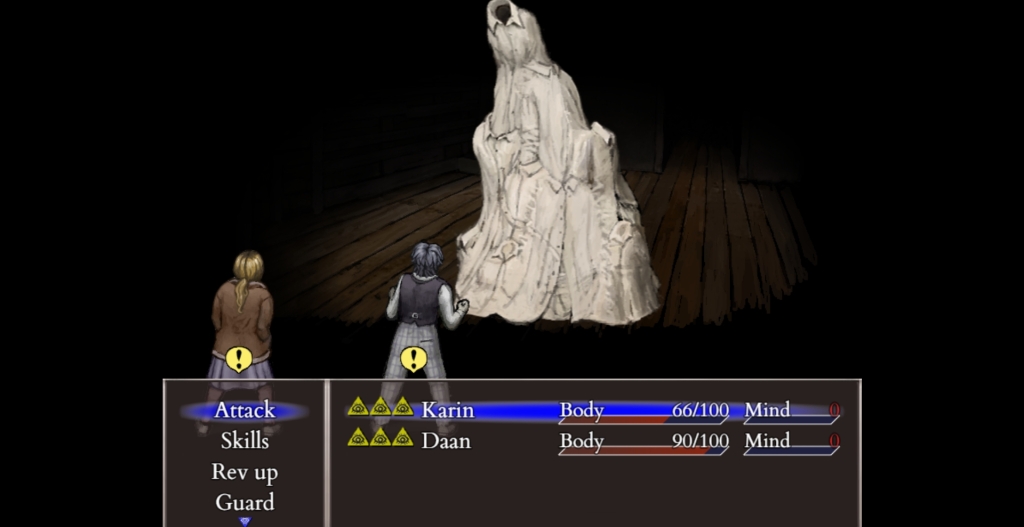
Appearance: The Obelisk is a cryptic and disturbing being, hidden in the silent depth of an abandoned shopping mall. After passing through lifeless mannequins, the Obelisk will be there, standing in the middle of the basement. The creature is a sort of massive tower made of clothes, specifically white man shirts, melted together in this structure. The Obelisk is a towering object, not clear if it is a living being or an investigable object. However, after interacting with it, the player can decide to attack the creature. But is this a wise decision?
Background: The Irrational Obelisk is a mysterious being breaking the conventional rules of the game. Hidden in the depth of an abandoned mall, surrounded by motionless creepy mannequins, the Obelisk apparently serves no purpose. It doesn’t provide a quest, dialogue, or any form of interaction. The player can indeed try to talk with the Obelisk, asking about its meaning, but the Obelisk will never reply. However, it can be attacked. But even the battle is a complete mystery. The Obelisk attacks only by draining your mind, bringing the characters on the edge of insanity, without having a direct way of harming them. And interestingly, by doing this, the Obelisk can inflict every phobia in the game. Strangely enough, the party can damage the Obelisk with anything, but it doesn’t show a direct weakness or susceptibility to status effects. The problem? The Obelisk doesn’t seem to die, no matter how many turns you attack it, or how close you are to becoming insane. It will simply stand there draining your mind. However, rumors say that the Obelisk can be killed, but with the insane amount of HPs (probably 999,999 HP), it will probably take hours. And who knows if the reward is truly worthy.
The Irrational Obelisk is the representation of how insane some quests can be, and how sometimes a battle is simply pointless. Fear & Hunger already deconstructed the genre before, for example with the Human Hydra (check more in my analysis HERE). But, while in that case, it was more related to the quest-effort/reward dichotomy, in this case, is more battle-effort/reward. And as the name suggested, the Obelisk is an irrational battle, so why even try to fight this being? Regarding the influences of the creature, in a recent interview here with the developer, Miro, he clearly stated how the Obelisk was influenced by a piece of modern art that he once saw in Finland. Moreover, the creator has an “irrational phobia for buttoned shirts”, and this being is clearly the embodiment of such fear. Here is the link to the interview, in case you didn’t check it: The darkest secrets of Fear & Hunger 2 Termina: second interview with the creator Miro Haverinen. Outside of RPG rules, the Irrational Obelisk is also a monolith to the irrational phobias, which drive away your sanity no matter how long you fight them. No matter how irrational, huge, or cryptic the phobias are, fighting against them is always a colossal effort.
Mary Skelter Finale is the end of the trilogy of dark Japanese dungeon-crawlers. Following for the last time the fight of the Blood Maidens against the immortal Nightmares to escape the living Jail, Finale is a huge game dense in new mechanics. And this time, the escape to the surface will hide even more dangers.
While the immortal Nightmares are still there, ready to chase the party around the mazes till they can be finally defeated (and you can check more about previous Nightmares in this analysis The Nightmares of Mary Skelter: fairytale characters reborn as twisted immortal stalkers), there are far more dangers, including a deranged and sadistic group of bloodthirsty girls: the Massacre Pink (or Genocide Pink in Japan). However, there is also a smaller but even more peculiar enemy waiting to surprise the party while exploring the Jail: the Insectmares.
This new danger comes from swarming enemies that can surprise the party during any battle, literally enveloping and crawling not only on the character but on the screen itself. Like under a sort of living negative effect, when a character gets swarmed by Insectmares, they receive several maluses. These range from the obvious bothering of having the screen almost entirely occupied by crawling creatures, to the impossibility of using any skill, attacking, or even trying to escape. Moreover, Insectmares also work as general malus, lowering, for example, defence or accuracy. And, as an untreatable plague, it is also quite difficult to get rid of Insectmares, which will continue to crawl on the affected character even when the battle ends. In fact, the only way of removing the Insectmares is by using blood, and a huge amount of it, coming or from the enemies critically killed, or by throwing essential blood packs.
The Insectmares are a new level of immune defense of the living Jail. If Nightmares can be the equivalent of macrophages or lymphocytes, actually hunting down external pathogens, Insectmares are more similar to antibodies, enveloping the external elements thus facilitating their destruction. In fact, the Insectmares are linked to the “angry” level of the Jail. Because if you fight or escape too many battles, or are chased by a Nightmare, without satisfying the Jail needs, such as Sleep or Hunger (yes, the dungeons here have feelings, you can read more here: Mary Skelter Nightmares: When the dungeon is a colossal living creature with its own needs), then the Jail will get angry. The higher the fury of the Jail, the higher the probability of being swarmed by Insectmares. This can happen at any moment: when in battle, exploring, and even when running away from a Nightmare. And the fact that this living and permanent negative status can appear in any battle, even bosses, regardless of their specific skills and powers, adds an additional level of anxiety and complexity through the game.
An additional details about the Insectmares lies in their name. While the English translation relies on their general insect-like aesthetics, together with their swarming behaviour, the original Japanese name is Babymare. This creepy name opens a new world of interpretation, somehow implying that they are a juvenile or larva stage of a Nightmare, their “baby” form.
Talking about their appearance, Insectmares are in general colorful beings, usually animal-based, but sometimes they can be more humanoid. However, while advancing in the game, they tend to get more grotesque, resembling animal-carcasses or disgusting anthropomorphic mutations. And yes, the fact that these creatures are literally crawling on you is quite disturbing.
Let’s have now a more detailed look at some of the Insectmares ready to crawl on you in Mary Skelter Finale. Since they lack a name, I simply created an unofficial one based on their appearance.
Stuffed Cows
The colorful cows cover the entire screen, appearing more like silly animations than disturbing beings. Worth to specify that these Insectmares are involved in the first tower of the game, associated with gold and judgment. As previously said, the Insectmares tend to get more and more disturbing in later towers, so, in the beginning, simply accept to be swarmed by silly and colorful cows. But wait, by closely looking, those cows have completely insane expressions, and their bodies look like stitched together. Well, maybe even in the beginning, Insectmares can be creepy.
Humanoid Bees
From one of the first dungeons, these Insectmares really fit their name. In fact, they appear as humanoid bees, with big red lights behind, colorful wings, a dangerous sting, and a set of peculiar humanoid features. The face is completely human, with a dumb-looking expression, pale void eyes, and a disgusting long tongue. They are in general more silly-looking than other Insectmares, but since they are in one of the first colorful dungeons, they still fit in the overall atmosphere.
Carcass Penguins
The penguins are grotesque and disgusting Insectmares, with beaks full of pointed teeth and feral expressions. Their bodies are already decomposing, appearing as decaying carcasses, with the ribs gorily erupting from their chest. At first glimpse, they could look like crows, but at a closer look, they are in fact penguins. This is supported by their appearance in one of the first towers, a cold and frozen environment. The simple idea of being surrounded and swarmed by a flock of these repulsive creatures is sufficient to send a chill down the spine. These Insectmares really break the rule, appearing as terrifying and grotesque beings in one of the first towers.
Eye Moths
The Eye Moths are the common Insectmares in a tower associated with blood and beauty, where gorgeous mirrors are scattered around, and blood is pumping from the ceiling. The moths are of a colorful ruby, to connect them with the blood-related topic of the tower, with a pair of gigantic eyes on their wings. They are quite graceful in appearance, and far less grotesque than the other Insectmares. However, when almost completely swarming the screen, having those giant eyes staring directly at the player creates a really uneasy feeling, almost breaking the fourth wall in a really unsettling way.
Three-headed Horses
The creepy climax of a Saturday-morning cartoon that went terribly wrong, these three-headed horses are probably the most disturbing Insectmares. The horses appear in the circus/carnival tower, a place of deadly games and disturbing beings. And their are really fitting there. The frontal face has a disturbing and insane smile, while the skin of its cheeks grotesquely melt with the other heads. And if you closely look at, the right head has its eyes almost melted inside the other skin. There is not a detail that it is not truly disturbing in this design, including the exposed ribcage with the heart beating inside. One of these creatures is already disturbing enough, but these small guys attack in a swarming and grotesque pack. You cannot unsee those terrifying faces staring directly at you through the screen.
Straw Dolls
One of the last Insectmares, these dolls are truly disturbing beings with nothing remotely cute or animal-based in their design. They live in a tower that looks like an hospital, full of living flesh and hanging ropes, so it is not a surprise that their appearance is so grotesque. The face is the most grotesque detail, composed of hard skin stitched together with red strings, even going inside a porcine nose. The mouth and eyes are completely filled with nails, an extreme and disturbing correlation with straw dolls stabbed with nails in black magic rituals. The limbs and body are simply straw bands roped together. The Straw Dolls are pure nightmare fuel, and simply seeing their stitched faces full of nails staring at you so close on the screen is already a gigantic malus on its own.




 Dark RPGs