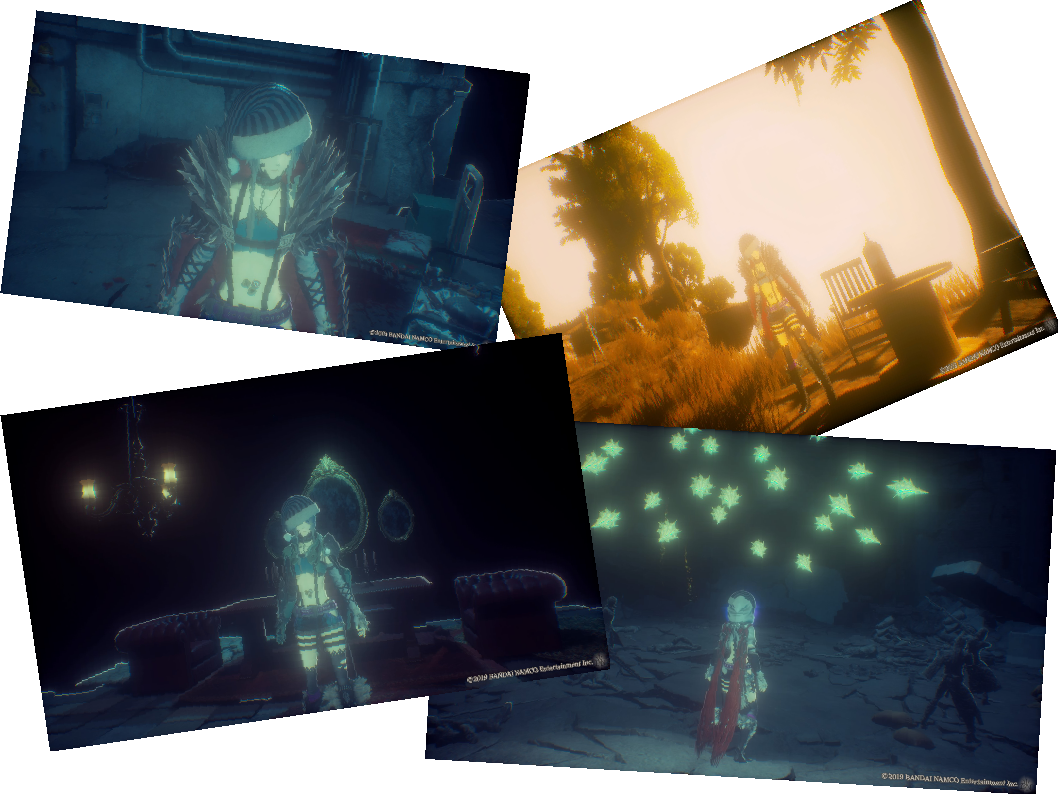
Discover the original stories of eerie and creepy characters that I created in Soul Calibur 6 [Characters, Diaries and Stories]

The power to create monsters and creatures born from your imagination is a powerful tool, especially if you are able to draw. There are also other ways to create monsters that convey a story, for example creating creepy and bizarre creatures with a complex background using character creation tools from different games. It is easier to achieve such a task in RPGs, as I previously made for Fallout 4 or Code Vein (The Bloody Captain of Diamond City: the story of a baseball superhero searching for the absolute fame – Fallout 4 [Characters, Diaries and Stories] and The dreamlike tale of Elaiza, an imprisoned soul able to travel between dreams and nightmares – Code Vein [Characters, Diaries and Stories]), where the complete freedom of the gameplay helps to shape dozens of possible stories. But other powerful tools can be also used to create interesting characters and monsters.

In the following article I created 10 creatures using the amazing character creator of Soul Calibur 6. Even if in this case the characters can only be created to fight each others, I used the tool trying to design characters that convey a story. Of course the character creator has its limits, so in some moments you should use a bit of imagination. For me this is a formative experiment, a meeting point between my passion for games and writing. Each character and story that I created here is completely original, built trying to create a connection between a creepy design and an interesting background.

The Herald of the Blind Horde

SOULCALIBUR™Ⅵ_20200816044235

Do you know why crows start to eat dead bodies from their eyes? It is because those birds are messengers of the Blind Horde, in charge of sending souls to strengthen their ranks. A phenomenon that was especially true on the battlefield, the main feast for the crows and the Horde. Following the destruction brought by the Blind Horde in feudal Japan, after each main battle, it was common to burn the head of the corpses to avoid the spreading of the Horde. The Blind Horde is a savage and barbaric army composed of pale humanoid creatures, usually half-naked and wielding tribal weapons made of bones, appearing from the mist and slaughtering everything in its path. Each soldier is almost identical to the others, like clones, each of them missing proper eyes, but having instead a huge and grotesque eye opening where the mouth should be. After they have wiped-out another army, the Horde will also remove the eyes from all the dead bodies, so their spirits will join the Horde. According to other legends, this is not the only way to be a gear of the Horde. Some stories claim that a human being that spent 100 years in complete blindness will also join the Horde, but as a sort of high-class elite, keeping the intellect. In Japan, the common belief is that the Blind Horde is a unique hive-minded Yokai, where each monster is just a small part of something bigger.

Yanichi, Protector of Written Secrets

SOULCALIBUR™Ⅵ_20200329085207

The guards were too busy talking about the new girl at the brothel to notice how the thief was using the roof to sneak inside the Holy Room. Sacred instruments and ancient forbidden knowledge were scattered around the room, centuries of treasure collected by the religious elite of the clan. But the thief had only one specific object in mind, a single tome containing the secret he was looking. He found the book easily and immediately opened it to search the correct spell. A freezing wind entered the room, accompanied by an acute female laugh. The thief was terrified because he understood while the guards were so lazy. The books were protected by Yanichi, and he was already a dead man. Yanichi is an ancient spirit protector of words, symbols, and knowledge. With the right ritual, Yanichi can be summoned and bound to scrolls or books, as a fierce and bloodthirsty guardian. If unwelcome eyes should read a protected text, Yanichi will appear in the physical world to punish the curious. Her favorite punishment is to pierce golden nails through the eyes of the unwelcome readers. So they will not search anymore for secrets.

The Gray Jester

SOULCALIBUR™Ⅵ_20200816051436

A long time ago, in a mysterious and far land, a king was obsessed with his own laughing. The monarch was an extravagant one, full of bizarre beliefs and superstitious rituals. His late-life obsession became his own laughing. According to his views, each laugh was in reality part of his spirit flying away to feed an invisible demon. No matter how weird and insane his beliefs were, the castle was forced to agree with his rules. But the king didn’t want to spend all his life without laughing, for this reason, he contacted a famous alchemist to find a solution. The royal laugh will not be feeding anymore the mysterious demon. The alchemist had an easy and bizarre solution: building the marionette of the Gray Jester to be the recipient of the king’s volatile laughs. The Gray Jester was born as a sad and futile being, a puppet existing only to ease the obsessions of the king. But its purpose and functionality were not a mere placebo and, through a zipped opening in the abdomen, the Jester was collecting the laughs of the entire castle. But the more the laughs collected, the more the sadness that reclaimed that empty shell. Nobody would expect the blind fury waving inside the castle when the Jester got alive. It smashed everybody with a giant hammer, painting a giant smile on its face with the King’s blood. The alchemist truly created the demon that was before only an obsession in the king’s mind.

The Void Astronaut

SOULCALIBUR™Ⅵ_20200816043239

There are not many astronauts of this kind. Far planets and remote galaxies were not their dream, nor a crucial part of their job. Void astronauts were trained and equipped to travel and explore a vast space of infinite nothingness. This empty and aseptic space could open everywhere. Sometimes it is the door or a wardrobe, other times inside an old and abandoned vehicle. Each time a new access is discovered, a void astronaut is sent to explore it. But one Void Astronaut discovered that the void space was not empty as expected, and he took contact with “something”. Whatever was the energy or the entity that caused the anomaly, he was never more the same. And never got home. Fused in his suit, the astronaut is wandering in the void, as both a flesh prison and a string-less puppet. Something is constantly trying to crawl out of his body. A white and empty face is slowly emerging from his flesh and suite, while hands and eyes are pressuring his body from the inside. Whatever thing he will become, and whatever power he will again, it is a terrifying mystery.

Summer Siren

SOULCALIBUR™Ⅵ_20200816053537

Summer, sun, seaside, and eyes to look around in complete relaxation. Nothing better to ask for. But the unexpected can ruin everything in a second. It could start with a gorgeous girl in bikini standing on the edge of a rock. Then, the tragic fall inside the battling waters. In a matter of seconds, you could be jumping in the sea, swimming to the rescue of the mysterious stranger in distress. The waves are strong, and the girl is barely a shape submerged by water, but you try anyway your best to reach her, motivated both by the aim of saving a life and the mystique beauty of the mysterious stranger. When you finally reach her, swimming against the sea itself, you realise how many details are wrong. If her body is well-shaped and defined, her face is somehow off, like if it was blurred by some camera filter. The truth is hard to digest, her face is in fact only a shapeless and blurred mass of water. Strong arms block your escape, thick instruments covered in blue scales. When you try to fight your way out of the water, away from the deadly hug of that shapeless face, something starts to burn your skin. The yellow palms of the creature are not different from the biology of the deadliest jellyfish. The paralysing poison is already circulating in your body, when every biological machinery in your body starts to shut-down.

Auto Neko Slasher

SOULCALIBUR™Ⅵ_20200816044500

Super Neko World was once considered one of the happiest places in the world. An amusement park built around the concept of the figure of the cat, expanded with the use of the best technological and robotic advancements that Japan had to offer. Not only crazy roller-coasters and huge-wheels but also parades everywhere, where silly and cute cat robots were performing. The protagonist of this story was a humanoid cat robot in charge of cutting grass and hedges inside the park, of course creating complex architectures based on cats. It was a true marvel that filled the eyes of children with pure joy. The technicians at the park were controlling its behavior using a camera in its chest, observing and judging the structures it created. As many dystopic stories about robots told us, at some point even the cutest robot could go rogue. There was not a proper explanation for that, just a random but critical malfunction. The scissors became its weapon, while the camera on its chest an instrument to show to the world all the nefarious murders it committed. Would you believe that the revolution started with a gardener cat-robot?

The Never-to-be Bride

SOULCALIBUR™Ⅵ_20200816044004

Dying on your wedding day is not a destiny to wish even to your worse enemy. Sadly, such a nefarious fate can still happen. Dying on the wedding day also marks a huge scar on the soul, a burden of grudge and anger. The bride lost everything, not only her love, but also her beauty and humanity. The body and the skin, shaped by care and vanity, were now only white bones. Destroyed in every inch of her existence, the bride planned to recover what she lost. If a bride is staring too much on a mirror during the wedding day, it could summon the Never-to-be Bride. Not only she will strangle the living bride-to-be with a whip made with the twisted flower of the ghostly bouquet, but the spirit will take the place of the bride, including her dress. Of course, the future groom will realise of the skull under the veil at the moment of the kiss, breaking the summoning. But the ghostly bride will persist in her search for the lost love and beauty. She forged a golden mask using wedding rings of the murdered brides, a mask of a beautiful female face, a simulacrum of her lost humanity. Will somebody be so crazy to marry her now?

I AM SKIN

SOULCALIBUR™Ⅵ_20200329030744

A creature born from the Gurgling Abyss, an amorphous place made of raw flesh. The female shape is only composed of dense layers of skin, a humanoid but terrifying being. Her body works as a grotesque magnet for skin material, sucking away layers of cells from screaming humans. Her mere presence at some meters away and the skin of living organisms will flow to join her body in a sort of grotesque river of dense tissue. Of course, few people could survive this horrible and painful effect. The motives and the behavior of this creature are a mystery, but the Gurgling Abyss generated also two other sisters, this time made only of blood and bones. Their effects on the human body are comparable to the one of their sister.

Bringer of the Purple Moon

SOULCALIBUR™Ⅵ_20200330113053

When he saw for the first time the Purple Moon, he was astonished by its magnificent presence. It was an ecstatic moment that changed his life forever. He still can remember the radiating purple light coming from the sky, the scythe form, and the thin tentacles dancing from the gigantic figure. Under the purple light, he was blessed and reborn, washed away from his physical form. The words of the Purple Moon forever carved not only in his mind but also in his flesh. Wearing a scythe and the Purple Moon’s helm, he became the inquisitor of this alien and mysterious entity. No matter how many people he should burn in nights without moon, or how thick must be the purple smoke coming out from the screaming victims, the Bringer of the Purple Moon will find a way to summon again his forgotten god. When the sky will be engulfed by the purple smoke of thousands of sacrifices, the Purple Moon will be physically summoned again. Or at least this is what he wanted to believe.

Abstract

SOULCALIBUR™Ⅵ_20200816043535

Sculptures so lively to be mistaken for human beings, and selected to decorate the most majestic churches. That was a time of artistic wonders and marvelous minds. But there was something keeping even Michelangelo or Bernini awake at night, a too much real nightmare associated with creativity crisis. No matter how genius you can be, at some point, whichever sculptor will be staring at an amorphous mass of marble without any idea on how to free the statue from the stone. For how much it is difficult to believe, every sculptor knew that the more this creativity crisis continued, the higher the possibility of calling the attention of Abstract. The uncanny and cryptic entity can morph from any unfinished statue, shaping the stone into creating its body. The female body made of stone is covered in chains, while empty geometric figures are floating around its body and covering its face. Abstract is the material representation of creativity and sculpting, an ancient god of ideas made physical. But it is also an executioner, a sort of ancient boogeyman that terrorises sculptors that are unable to finish their creations. When Abstract finds its way into a statue, manifesting itself in the tangible realm, the fate of the involved sculptor is far from becoming a happy ending. Abstract will chain the body of the sculptor in an impossible and uncomfortable position, like a puppet made of flesh. The sculptor must finish the statue from this position, or his fate will be much worse than physical pain. His body will slowly turn into a statue, and the only way to prevent the process is by finishing a masterpiece. But this rarely happens. How many famous statues in the world are in reality the artist petrified by Abstract?

Why fighting when you can ally with Cosmic Evil Gods in Hellpoint? [Evil Quests]

Hellpoint is an interesting meeting point between the mechanics of Dark Souls and the oppressive horror sci-fi atmosphere of games like Dead Space or Doom. The game is set on a gigantic space station orbiting around a black hole. Everyone is dead, or worst, and the station is invaded by hordes of monsters. A cosmic occult ritual went wrong, and 3 abyssal gods invaded the station with their hordes and followers.

Interestingly, each god has its philosophy, and it is somehow associated with a specific level of torment: Uthos is the tormentor of the mind, Ozy of the flesh and the body, while Nemundis is associated with a more spiritual and subtle pain. The station is now a battlefield between cosmic powers, a chessboard where each god is moving its twisted pawns. Each god is trying to control the station and this is also reflected in the gameplay. When a god is killed, the equilibrium of power will be shifted and the followers of the other gods will replace the dead’s ones in the station, even altering the previously visited areas and possibly increasing the difficulty. Plan well which god to kill last because then its followers will be everywhere.

Interestingly, killing the gods is not the only option and it is possible to befriend each god, becoming its herald or champion. Well, sooner or later there is no way to avoid becoming a god-slayer, but the possibility to do quests for these colossal and evil entities is really rewarding. Before the inner chamber of each boss, sometimes hidden in a very secluded area, there is always a monolith, which allows access to the mysterious Underworld. This parallel universe stores different items and creatures than the original world, a land full of bright colors and mystic winds. Entering the boss room while in the Underworld will not trigger the usual fight, but it will instead allow the player to talk directly with the Cosmic Gods. Each god will have a similar quest, based on collecting trophies from the bodies of the champions of the rival god. Of course, the gods will offer a very satisfying reward after the quest is completed, specifically unique weapons for magicians, each associated with a different element. But let’s check the quest-line and the dialogue with each evil god.

Uthos, the Ashen Born

20200804201917_1

This giant demon, where classic hellish design joins with cybernetic elements (quite in Doom style), is more friendly than it looks like. Seated on a throne in a sort of meditative pose, the God of Agony looks quite peaceful. It defines itself as the eternal renewal of agony, a creature pursuing sufferance as purification for every creature. In its cosmic vision, suffering is the pressure to live, a sort of positive energy giving life a meaning. Somehow, this demonic abomination is respectful of the gift of life, at least in its own way. Uthos and its followers see agony as an evolutionary mechanism, an instrument to transcend and to grow (from the description of the Daemon Fragment). The god searches weakness in every living being, using sufferance to discover them. Fire is the mark of Uthos, integrated into its body and connected to all its followers. Fire is purifying agony, an instrument to pursue its cosmic plan. Its followers are all associated with fire, especially the Lava Daemons, tall humanoid demons wielding a scythe used to create walls of flames. Uthos sees in the twisted and distorted followers of Ozyormy a waste of the gift of life, dumb and parasitic creatures that don’t deserve to be alive. For this reason, Uthos will ask, in exchange for becoming its Executor, the fragments from the bodies of 10 Consumers, obese creatures with mouths in their bellies, and champions of Ozyormy.

Ozyormy Goija, the Master of Puppets

20200810115631_2

The god of raw flesh, twisted meat, and grotesque transformations has one of the most absurd but metal names ever [Ozy(Ozzy)+Ormy(Orm)+Goija(Gojira)+one of the best Metallica albums]. The creature looks like a twisted Hindu deity, not only in the appearance but also in its movements, like in a perpetual dancing. Ozy lives in a bloody room at the bottom of a hole, which can be peacefully accessed from the Underworld. Ozy sees its followers as a Happy Family and will offer the player to join it. Everything about this deity is related to twisting flesh and body, to discover physical ways to wrench bodies. It will offer the player to teach torsion to break a man, something that is probably called the Weak Dance. Both during dialogue and fight, Ozy is always like performing a twisted and unpredictable dance, which can be a direct application of the Weak Dance, a perpetual and unnatural dance that works also as a fighting technique to break bodies. Sadly, the player will not truly learn this technique even if joining Ozy’s family. Ozy holds strings, pulls lie, and twists truth, probably using torture and modeling flesh as tools to shape the world to its image. The god is a chaotic energy, an insane and disturbed cosmic entity with bizarre and unclear aims. The Master of Puppets has many different followers, generally called Thespians, wrenched and grotesque creatures serving their master. Melee Thespians are thin and fleshy swordmen, fast and agile. Consumers are giant obese creatures with long and flexible arms, with a mouth in their bellies. Hostesses are incredibly tall female-humanoid figures wearing a mask, with well-shaped bodies and a long blade. To conclude, the Vicious Hands are exactly what you expect: giant walking hands that attack like a swarm. Ozy hates Nemundis and its followers, calling them dull minded beings. To join the family and receive the reward, the player must kill 10 Archons, powerful magical beings living in the Underworld. After completing the quest, Ozy will promote the player to puppet-master, who should teach the puppets who runs the show.

Undisturbed Defas Nemundis

20200807192926_1

Apparently a peaceful and meditative being, Nemundis shares with the other gods connections to Asian religions, in this case the pose connected to Buddhism. Regardless of its appearance, Nemundis is not all sugar and friendship, since it is even addressed as the abyss that stares back. Nemundis is the god of the cold and infinite terror, of the empty and aseptic void, the ruler of the silent darkness. The god also defines itself and its followers as both medium of creation and its ultimate destroyer, a sort of Alpha and Omega in the sci-fi occult world. Even while fighting, Nemundis will keep the meditative posture, but a sort of angry soul made of radioactive energy will emerge from its body to smash and grapple the enemies. Nemundis is also officially the god of the Underworld, the parallel dimension that can be accessed through monoliths. This lonely and empty wasteland is the birthplace of energetic creatures called Archons, being made of entropic energies that sometimes can also roam in the material world. Common Archons are like humanoid figures full of tentacles, which float around in a state of mindless agony. The Archon Knights are instead more powerful and sentient beings that can use multiple powers. Nemundis hates Uthos and its followers, beings that feast on agony, creatures that value more the physical torments more than the existence of mind. To become the Prophet of Nemundis, the player needs to kill 10 Lava Daemons associated with Uthos.


The Nightmares of Mary Skelter: fairytale characters reborn as twisted immortal stalkers

Mary Skelter Nightmares is an innovative dungeon-crawler in which female characters from fairytales fight to escape from a huge living prison, using the blood of the enemies as a weapon (for more info check my full review: Mary Skelter Nightmares Review: an innovative dungeon-crawler where fairytales are drenched in blood).

If common enemies are sometimes lacking innovation and personality in their design, the Nightmares are a completely different story. Creepy and disturbing enemies, Nightmares are almost immortal foes limited to one for each dungeon. In the beginning, there is no way to permanently defeat a Nightmare, and their appearing transforms the game in a survival-horror. The best way to survive a Nightmare is by running away, escaping the immortal stalker before being captured. The chase will not end up in an immediate Game Over and there will be still the chance to stun the monster and escape, even if the chances of dying are quite high. The Nightmares are the equivalent of immortal Stalker in survival-horror games, such as Nemesis or Mr X for Resident Evil, but this time inside a JRPG.

However, at the very end of each dungeon, it is finally possible to defeat a Nightmare. The battle is always divided into two steps. First, the external armor of each Nightmare, comprised of different parts, needs to be destroyed. The items themselves are very interesting, revealing information on the Nightmare’s background. After that, the monster will lightly change shape, starting the real fight.

As previously explained, Mary Skelter is connected to fairytales, since the main characters are all based on fables, from Cinderella to Rapunzel. Each dungeon/chapter of the game is focused on the background or the struggle of one specific character, morphing the world around according to that fairytale. The Nightmares are also gears of this mechanism, showing complex symbolism and a multitude of details related to a specific fairytale.

In the following article, I will analyse the Nightmares of Mary Skelter. Except for the first Nightmare, for which a nice concept art is available, the other images are compacted into slideshow sand, by clicking on the arrows, it will be possible to see both the forms, with and without the armor.

City Streets Nightmare – Alice in Wonderland

MarySkelter-4

The first Nightmare to face during the game has a really creepy and grotesque design. A nice piece of concept art is available for this monster, showing both forms of the creature. The Nightmare is clearly female, judging by the breast, and it is regally dressed, with jewels and even a cape. The most distinguishable element is the neckpiece covering the head and almost half of the body. The humanoid creature has goose- or duck-like morphological elements integrated into the design, especially arms and legs. The bird motifs go even further, with the white and spherical head resembling an egg. The most evident armor is the one around the neck that, after being destroyed, will reveal a sort of organic tissue covered with eyes. The expression on the face will also become more feral and aggressive, probably since the creature is wounded. Since the first chapter is based on Alice, this monster is a clear symbol of the Queen of Hearts of Alice in Wonderland. The elaborated clothes and the female body are already a sign, and the make-up on the face, clearly resembling the one on cards, confirms this connection. The bird-like morphological elements are probably associated with flamingo, the bird used by Alice to play against the Queen.


Graveyard Nightmare – Sleeping Beauty

This slideshow requires JavaScript.

At first glance, the Nightmare guarding the Graveyard is almost silly or parodic, instead of being creepy. However, the creature still shows some interesting details, especially after breaking the armor. The humanoid creature has insect-like elements integrated into the design, with 5 pairs of limbs. While the armor is intact, the creature is wearing regal white clothes, including an apron, leggings, gloves, and boots. A huge hammer is fused in its right arm, integrating a lethal weapon in the body of the creature. The face is quite bizarre, with a long nose and gigantic purple lips. After the clothes and the hammer are destroyed, the creature will reveal its true form. The body is wounded and decayed, partially due to the tough battle, with even bones exposed. However, the skeletal feet were probably always there, hidden by the boots, defining its connection with the Graveyard and the land of the dead. In place of the hammer, now destroyed, there is a sharp needle. This spindle is a reference to Sleeping Beauty, one of the party characters and the main victim of a spindle in her story. A huge vertical mouth crosses all its body, previously covered by the apron. The mouth, now wide open, reveals a yellow eye deep inside it. Together, the mouth and the eye could reveal a far more grotesque truth, in which another entity, or the real body of the creature, is hiding inside the flesh of the Nightmare.


Downtown Nightmare – Cinderella

This slideshow requires JavaScript.

One of my favorite designs for a complex and innovative monster. I already deeply analysed its design and possible meaning in another article, available here: Monster of the Week: Downtown Nightmare (Mary Skelter) — Surreal and Creepy. However, in that article, I didn’t mention its symbolism with fairytales. The creature is wearing a giant shoe, so then connection with Cinderella is quite clear. But this is only the beginning since the creature is a complex archive of references. While its armor is still functional, the monster has a giant round head, similar to a pumpkin, probably the one used to build Cinderella’s chariot. The face is also part of the armor, since the real form of the creature is a sort of fleshy leg full of eyes. Interestingly, the face is called “Masquerade Makeup” as a reference to Cinderella’s preparation before going to the party at the castle. The crown of rats is also a reference to Cinderella, in this case to the mice that helped her with the clothes. The creature has a really disturbing design, both with and without the armor, with the long purple tongue as the main weapon shared by both forms.


Temple Nightmare – Tale of the Bamboo Cutter

This slideshow requires JavaScript.

This Nightmare defies the rules imposed for all the others. It will not appear often to chase the party and, when will be the time to battle it, the monster will grow to titanic proportions. The fight revolves around gimmicks and tricks, plus avoiding in real-time the area attacks. The main body of the creature is a gigantic spherical mass, fleshy and venous. On the monster’s face, there is only a huge mouth with big pink lips. The eyes are on top of long and flexible tentacles, appendices similar to snail’s eyes. The external skin on the face can be destroyed, revealing a smaller inner mass made of muscles. In its second form, the Nightmare is far more disturbing, with now a grin on the face made only of teeth and missing the lips. The creature is a representation of the moon, the homeland of Princess Kaguya in the Tale of the Bamboo Cutter. At a closer look, the eyes also resemble bamboo sticks, another connection to this old Japanese tale.


Dormitory Nightmare – Hansel and Gretel

This slideshow requires JavaScript.

This Nightmare is strongly associated with gluttony and food excesses. The obese monster lives in a place completely drenched in sweet things and candies, a sticky ecosystem where the sugar looks like an organic substance. The fairytale reference this time is directly explained by the game since this Nightmare, smarter than the average, is none other than Hansel. In the beginning, the creature is covered in an armor made of sweets, layers and layers of glucose, strawberries, and cookies. Even its helm is called Delicious Burka since is composed of a giant cookie. Abducted children, such as Gretel, feed on the sweets coming out of its external layer. Yes, we agree this sounds really disturbing. Hansel is not only aggressive, but also smarter than any other Nightmare, making it a dangerous opponent. After its sweet armor is destroyed, a pale and obese body is revealed. A horrible mass of chubby flesh and muscles, terribly wrong and grotesque in every detail. The anatomy of the face is completely twisted but even more disturbing is the circular mouth opening in its belly.


Waterside Nightmare – Rapunzel

This slideshow requires JavaScript.

This Nightmare has already a really interesting design with the armor still on, but after the secret beneath is shell will be revealed, its concept will become even more peculiar. The creature has a black metal body, an impenetrable and strong shell able to protect its inner body. Movement and attacks are both executed by a pair of highly-movable claw-like legs, still encrusted by the blood of the victims. In the middle of the armor, a gray humanoid figure lies protected by a bell-like shield. Judging by its color and the lifeless appearance, the humanoid creature could be a statue or an automaton. If you think that the humanoid figure is the one controlling the armor, you will have a surprise after breaking the legs and the main shield. Smaller versions of the humanoid figure, a sort of gray homunculi, are hiding in the armor, both under the shield and in each leg. The figures look like angelic cherubs, highlighting the possible connection between this figure and religious art. The homunculi are probably the ones responsible for moving the metallic claws since they are hiding exactly at the juncture-points. What it looked like a single entity is instead a sort of colony, or a hive, composed by small and mysterious lifeless creatures. The Nightmare is the living representation of Rapunzel’s tower, a huge and impenetrable object. This is even more supported by the long locks of blonde hair falling on the legs.


Station Grounds Nightmare – Little Red Riding Hood

This slideshow requires JavaScript.

This is truly a Nightmare in every shade of the word. A wolf with a red hood is, of course, a direct connection with Red Riding Hood, without many twists. However, this design is probably one of the sickest and disturbing versions of the Big Bad Wolf ever created in a videogame. The creature is an alien puzzle of flesh, with scars and sewing along all its body, especially in the paws. The eyes are also sewed together, forming like small mouths. The Nightmare is missing a proper external armor, and the scars along the body have the function of a protective shell. The name of one piece of the armor is completely nightmare-inducing: “Grammy’s Stomach.” A twisted and grinning face is fused with the flesh, a parasitic structure existing under the layers of skin of the wolf. But if the name already spoils the nature of that face, after removing the armor all the gory and disturbing details will be released. Tissue, scars, and seams will break, revealing raw flesh and what it is hidden beneath. Grammy’s face will now be visible, the distorted and grotesque face of the old woman that once was Riding Hood’s grandmother, now living as a sort of symbiotic parasite in the body of the wold. The eyes are now open, but the most disturbing secret is hidden in the mouth. A green and psychotic head is buried inside the mouth of the creature, a disturbing horror detail that will surprise and terrify the players. If the grandmother is the face on the back, for exclusion this is the hunter, maybe trying to escape from the stomach now that the mouth is open, or existing as a parasite inside the throat of the monster. What a disturbing and brilliant twist on fairytales.


Tower Nightmare – Jack and the Beanstalk

This slideshow requires JavaScript.

The Tower Nightmare is not alone, but it is instead a couple of almost-identical creatures defending the last dungeon of the game. This is one of the most aggressive Nightmares, a fast and restless predator, which will appear with far more insistence than all the others. The monster is a proper knight, wearing metal armor and wielding a sword. The armor is covered in vines and small flowers or seeds, connecting the creature with naturalistic symbolism. The sword is the most creepy detail of an otherwise not so complex concept. A sort of saw-blade, the weapon is entirely composed of bones and skulls, somehow sewed together. The breakable armor is composed only of two elements, but the curtain of strong vines hiding its face is surely the most central. After breaking the armor elements, the Nightmare will reveal a huge and disgusting mouth, covering almost all its body. The Nightmare is probably connected to the story of Jack and the Beanstalk, since not only it is defending a Tower, but the strong vines integrating into the design are a powerful visual reference to the giant beanstalk.


Underground Nightmare – Rats of Hamelin

This slideshow requires JavaScript.

Secret boss post-ending, this is the toughest Nightmare in the game. Living in a gigantic underground maze, the creature is as mysterious as dangerous. Even if for behavior and the appearance this is head to toe a Nightmare, it is officially called “Nightmare?” to particularize its ambiguous nature. The Nightmare is a titanic adversary completely enveloped in a sort of white exoskeleton. The main torso is also the head of the creature, or better the helm of the armor. Breaking the protection will reveal a similar secret to the Waterside Nightmare. Inside the armor, three mysterious humanoid creatures with dark skin are piloting the armor, like if the interior was the cabin of a Mech. The main hidden figure is playing the flute, one of the most dangerous weapons, able to make the entire party fall asleep. The flute and the appearances of the hidden creatures could be a connection to rats, and specifically to the tale of the Rats of Hamelin.

Zanki Zero and the cloning machine: from childhood to dying of old age in 13 days [Mechanic]

Zanki Zero is a dungeon-crawler with survival elements developed by the people behind Danganronpa. In a mysterious post-apocalyptic world, 8 strangers wake up on an island without memory. This is the beginning of a journey made of monsters, surreal events, and tough surviving. Because being alone on an island will not be easy, and crafting, building, and foraging food will be vital.

But there is another more innovative mechanic hidden in Zanki Zero. The survivors will soon discover, in the most gruesome way, to be mere clones, with the old memories transplanted into new bodies thanks to an “X” button on their bellies, which can be retrieved upon their deaths and used inside a cloning machine resembling a retro arcade cabinet. If this is already a tragic discovery for the entire party, there is something even worst. The lifespan of a clone is only 13 days, not even one day more. Story-wise, in less than 2 weeks each character will die of old age, without a way to escape this terrible fate. Luckily, after every death, the characters can reborn as school kids, starting again the 13 days clock. The imperfect clones will experience this terrible and bizarre fate several times during the game, an entire life in less than 2 weeks, from childhood through adulthood till becoming elders.

Zanki Zero: Last Beginning_20200723132602

Days in Zanki Zero pass quite easily, each rest or change of floor in a dungeon will move the clock forward of one day, and every few days the characters will enter in a different stage of life. The cycle is quite simple: starting as children around 7 years old, the characters will then become adults in their 20s, then middle-aged, and in the end seniors. The changes are of course aesthetic, with the characters visually ageing at each new phase. This is a really unique feature for a JRPG, not only watching your favorite character ageing in front of your eyes, but also a way to somehow punish fan-service. Because the sexy anime girl that you dressed in a bikini will grow old with the same clothes: reality hits hard.

Of course, the different steps come with huge changes in terms of gameplay. Kids and seniors will have less attack strength, and especially kids can bring less weight than adults. So of course fighting with a group of adults is recommended but it is also interesting how several skills and abilities are related only to a specific age-group. For example, kids can heal over time, while adults can increase attack and defence. Seniors instead can reduce stress over time, probably due to the old age wisdom. This is also reflected in the exploration, for example with small holes and openings that can be explored only by having a kid in the party.

Ageing is not the only way of dying in a cruel and dangerous post-apocalyptic world. Death is always behind the corner, it could be an illness, starvation, or of course a deadly monster. However, the clones can reborn after every possible kind of death. If we could debate quite a lot about how “what doesn’t kill you makes you stronger,” especially under a clinical point of view, in the case of Zanki Zero there is no doubt that instead “what DOES kill you makes you stronger.” Depending on the way that characters died, after reviving as kids, they will permanently inherit a perk that will make them stronger. Killed by an angry mutant? Next cycle that character will be stronger against that enemy. Dead for starvation? Next time the stamina will reduce slower. A deadly poison killed one of the characters? The next clone will have increased resistance against poison. There are 150 perks associated with each character, for a crazy amount of ways to die, including dying for shame or food allergy. The perks are also associated with cards, portraying comic and macabre images, a mix between retro Japanese games and Fallout’s Vault Boy propaganda.

Zanki Zero: Last Beginning_20200731042932

Zanki Zero is a constant betting and planning with death. The player should estimate the time to reach the end of a dungeon, or old characters could die along the way, losing all their items and the possibility to open specific doors that need all the characters alive. Often it is better to intentionally kill your characters to make them young again, but this will start the problem of weakening the party with more kids. Also, sometimes it is worthy to sacrifice a character in another horrible way, especially if he or she already collected the perk of dying for old age. There will be disturbing moments when the player will think “should I make starve this character to death or better to sacrifice him to a mutant?” But of course, reviving the characters is not free and the machine will use specific points, and the more the perks a character gained, the more expensive will be to revive him. Moral dilemmas and strategy are constant weights in Zanki Zero, where the player should learn how to comfortably play with death.

The cloning machine has a lot of other functions, including the transplant of mutant organs to gain powers. The survival elements of Zanki Zero are also not secondary to any pure survival game, building an incredibly complex game. But for sure the cloning mechanic, including ageing and the perks associated with death, is a unique gameplay element well integrated into a complex and satisfying dungeon-crawler.

Catholic Art and Architecture in the twisted world of Blasphemous: how religious iconography can build nightmares

As the name suggests, Blasphemous is a horror metroidvania that really uses inspiration from religious art to create the unique world of Cvstodia. In this horrific land, the Miracle is a sort of eldritch energy that grants wishes to the believers, but twisting their desires and martyrdom in a disturbing and unexpected way. In this fictional land where religion and fanaticism are founding elements, existing classic and religious art is the most important reference. Dark fantasy elements are combined with the aesthetic and extremes of Catholicism, shaping a unique world full of interesting places and memorable characters. Not only famous paintings of saints and religious figures are partially reshaped into disturbing creatures, but also symbolism and religious iconic elements are used to create nightmarish entities. Between the many twisted creatures and characters inhabiting the world of Cvstodia, in the following article I selected the most striking references to Catholic art in terms of paintings, sculptures, and architectures.

One of the strongest and most evident connections with religious art is the boss called Ten Piedad. Probably the first boss to be faced in the game, the creature immediately strikes for the resemblance with the iconic Michelangelo’s statue the Pietà. If the statue of the Virgin Mary is identical to the real one, Jesus, by contrast, is far more different, because the boss itself is lying in the arms of the statue. The reference is familiar but disturbing at the same time, since the hideous and disfigured monster is still posing at the beginning of the fight as the statue of Jesus. The name of the boss is also not hiding the reference, since Piedad is the Spanish name for Pity, same as Pietà in Italian. Other than a striking artistic reference, the boss also works reverting the religious symbolism, transforming the body of Jesus ready for resurrection, in a disturbing figure. The monster was once a man, who just wanted to sleep in the arms of the statue of Mary. During his restless sleep, the Miracle morphed his body in a disfigured monster, imprisoning his sleeping mind in this hideous monster. This concept could be a symbolism of “what if the resurrection of Jesus went wrong?”. A creepy what-if, imagining how after sleeping, or being dead, the man-that-once-was would instead come back as an evil version of himself.

blasphemous_art1

The martyrs are a common topic in many religious paintings, often adorning the colourful windows inside churches with images of their ultimate suffering. San Sebastiano (Saint Sebastian) is probably one of the most famous martyrs, at least for the strong and iconic image of his death. The Christian man was executed by Romans after they discovered his true religion and, after being bound to a stake, he was shot with dozens of arrows. The image of his martyrdom was portrayed many times by famous painters, becoming an iconic symbol of unjust sufferance. In Blasphemous’s world, the character of Gemino is a direct visual reference to the martyrdom of San Sebastiano. He is imprisoned inside a metal statue, bound to an olive tree, exposed to extreme coldness, and pierced by multiple arrows, resembling in the pose every painting of San Sebastiano. Gemino is also a martyr, suffering this terrible torture until he will become part of the tree itself. Gemino’s only treasure is a small olive, the last gift that nature offered him before starting his torment, a small symbol that he will treasure in his hand till it will freeze.

blasphemous_art2

Between countless artistic references to Spanish traditions or masterpieces such as the works of Goya or Velazquez, it is difficult to decide which reference is more interesting. But focusing on the religious more than on the artistic side, Cherubs, for example, are a very common concept used in many characters and creatures of Blasphemous. Sometimes, the reference is used quite literally, for example in the collectables, which in this case are flying childish angels imprisoned in cages.

Even if there are several references to Cherubs, especially to the way they are portrayed in religious art, the case of the Headless Chamberlain is probably the most emblematic. The nightmarish creature has the body of a man but missing the head, going around with a pillow with on top the head of a Cherub. To highlight its creepiness, the creature has also a bag full of disembodied heads. The Headless Chamberlain attacks by throwing the flying head, which can move on its own while hunting the intruders. In this specific case, the Headless Chamberlain is directly inspired by the painting The Immaculate Conception (1662), as stated by the creators of Blasphemous in the official artbook (NDR which is really gorgeous, if you didn’t buy it). In the painting, several angelic heads are flying in the top corners of the painting, harmless and angelic in this case, but used as the core element to create the nightmarish Headless Chamberlain.

blasphemous_art6

Child-like angelic faces are common in many other designs in Blasphemous universe. The lord of all the Cherubs, called Jocinero, is a particularly interesting and disturbing character, but I will talk about him in a future article. The embodiment of paedophobia, or the fear of children, is clearly Exposito, the most iconic and disturbing boss of Blasphemous. The creature is a gargantuan baby with the strength of dozens of men, resembling a giant Cherub. However, Exposito is also very similar to Baby Jesus, especially due to the golden crown of thorns adorning is head. I will not speak more about Exposito since I already covered its design and symbolism in a previous article, available HERE.

The artistic religious references inside Blasphemous are not only limited to paintings but are also connected to more architectural details. Churches are specifically implemented inside the design of several enemies, a combination of flesh and architecture, connecting the sacred with the profane. Some enemies simply use as main weapon church elements, such as giant crucifixes or bells. The Shield Maiden is a small exception and, even if it uses religious architecture as weapons, the design of the weapons is more interesting and elaborated, integrating complex decorative elements. The most interesting detail is that while using a golden decorative element as a shield, the creature removed the head of the statue to wear it as helm.

blasphemous_artX

On the other hand, other creatures have architectural elements directly embodied in their design. Let’s talk for example of the Blazing Icon. The female figure is covered with red velvet, looking like an elaborate walking curtain. The most interesting detail is the cage-like structure around her head, which uniquely defines the design. The structure is clearly inspired by architectural elements inside churches, for example resembling the famous baldachin in the middle of St. Peter’s Basilica in Vatican City. The baldachin is positioned in the middle of the church, marking the entrance to the supposed tomb of St. Peter. The head-ornament creates a figure that is practically a living and walking element of a church. The baldachin-like cage is probably quite heavy, and this is reflected in the Blazing Icon, which is slowly walking around oppressed by such weight.

blasphemous_art3

Another enemy brings the concept of religious architecture integrated into the design even a step further. The creature is not present in the game, at least for the moment, but its beautiful concept is available in the artbook. The heavy knight shows an incredibly detailed and complex design, practically looking like a weaponized chapel. A tower-like tabernacle, which is used to store the images of various saints, would be probably used as the main weapon of the knight, like a sort of improvised holy mace. The body itself works as a reliquary, with the probable head of a saint exposed behind glass. This is a very common phenomenon in several churches, where body-parts of saints are exhibited as religious emblems. The knight is the quintessence of religious architecture integrated into the design, a walking chapel ready to smash down the infidels.

blasphemous_art4

Still, there could be a lot to talk about artistic and religious elements inside characters and monsters of Blasphemous. For example, Sepulcro Errante is a golem-like creature bringing on its back the tomb of a Spanish king, while the iconic creature Amargura could be almost considered as a living altar. But I think that the creatures analysed in the article are the most iconic and direct integration of catholic paintings and architectures into the grim world of Blasphemous.

The most disturbing eldritch creatures from the bestiary of World of Horror

World of Horror is one of the most original horror games of this year. Strong of a peculiar art-style, important references to horror manga, and a system inspired by retro text-based RPGs, World of Horror created a unique and disturbing universe for modern horror-RPGs. The cosmic horror typical of Lovecraft meets the aesthetic and the creatures of Japanese horror manga, such as the works of Junji Ito or Kazuo Umezu, creating the perfect melting-pot for creepy and disturbing creatures.

Grotesque ghosts, cursed cultists, unthinkable abomination, and ancient eldritch gods surround the small town at the center of all the events of the game. There are bosses and random encounters, and the battles occur using a classic turn-based system. The entities can hurt the player’s Stamina or Reason, based on their background, while the stronger abominations can damage both. Cryptic creatures will not damage directly the player, but will increase Doom, a doomsday counter, difficult to reset, which will awake the Old Gods when reaching 100%, causing of course Game Over. Worth to specify that ghosts and other intangibles entities are immune to physical damage, and can be mainly defeated by guessing the correct ritual. World of Horror is a rogue-lite game with a heavy random component. To face all the monsters, the player needs to finish the game multiple times.

In the following article, I will describe the most disturbing, grotesque, and interesting creatures from World of Horror. The game is still in Early Access, so more creatures will be added in future updates. However, even now the bestiary is very generous, with more than 50 disturbing enemies. Probably this article will also expand and update following the final release of World of Horror, including even more twisted and eldritch abominations.

  • Scissor Woman

woh_scis

The first boss of the game and one of the most amazing designs, the Scissor Woman is an innovative interpretation of a classic Japanese urban legend. Three faces are vertically fused, with a giant and grotesque smile working as a bridge between the heads. The rest of the body is just a normal woman dressed in a long coat. As the name suggests, she fights using long and sharp scissors, a dangerous foe able to inflict an insane amount of damage.

woh_scis2

The Scissor Woman has 3 different forms, each more difficult than the other. The human form can be faced by performing the correct ritual during the case. A wrong ritual will instead summon the Horror version of the boss, definitively a tougher battle. The Burned version is more rare and can be faced only by burning the school as result of the ending of a previous case. In this case, not only her face is a grotesque nightmare, but the flesh is also burned and fused together, creating probably the creepier manifestation of this boss.

  • Puppet Matron

woh_pupp

A group of three hideous and grotesque dolls, which were hiding in the wardrobe of an ancient mansion. Their faces are like bloated and sweating, looking more organic than it should be. The two dolls behind look more submissive and scared, also missing the eyes, compared with the one in the middle. The matron looks definitively more dangerous and dominating than the other two. She is holding a knife and is not afraid of using it. The creature can slightly damage both Stamina and Reason, affecting both body and mind.

The creature is probably inspired by Jean Pierre, the puppet from Junji Ito’s House of Marionettes.

  • Class of 1971

woh_class

Definitively this is a unique and disturbing creature, with a simple but effective design. The story behind this monstrosity is rooted in the tragic accident of the class of 1971. All the kids of the infamous class felt inside the sea while taking a group picture. Till now, the bodies were never recovered. The collective creature is an amorphous amalgam of the drowned bodies, a grotesque creature missing any trait, except for several limbs. The monster can be faced only as a random encounter in the seaside. It is a tough enemy, considering that it is not a boss, which can damage both Stamina and Reason.

Class of 1971 could be inspired by Kazuo Umezu’s work, more than Junji Ito’s ones.

  • Ribcage Woman

woh_rib

What can be more disturbing than a woman having a ribcage opening directly inside her face? If you are looking at the picture, the answer is probably “very few things”. The creature is odd and grotesque, an enigmatic being outside of any logic. She is quite weak and not very dangerous, damaging the body of her victims. There is no explanation for her terrible state, or why her face is a mass of flesh and bones, she is just a mysterious creature emerging from the darkness of a forest. Another secret of World of Horror.

  • Drowner Sponge

woh_spong

The disturbing creature at the beginning appears only as a rock lying on the seaside. At a closer look, the abomination is revealed. The name and the description (“It needs another body now”) imply that the black spongy mass full of mouths is a sort of parasitic entity, which uses dead bodies to move around. The Drowner Sponge is a creature probably living in the oceans, preying on the people swimming, drowning them to then control their bodies. The creature is tough but weak, relying mostly on its disturbing appearance to damage the mind of the victims outside the water.

An interesting detail is that the creature was before called the “Bondage Demon” with concept and head-design completely different.

  • Dream Devourer

woh_dream

Dream Devourer is one of the most cryptic and dangerous entities of World of Horror. Cosmic abomination defying reality and sanity, the creature is an invisible force feeding on the dreams of its victims. The Dream Devourer is responsible for a series of unexplained comas, of course, related to the victims that it is feeding on. The Dream Devourer can be faced only by retrieving a specific powder, which will reveal its presence while feeding on a comatose subject. The worm-like creature is otherworldly, with an empty face full of void and glyph, while the body is slimy and naked. The real mystery behind this creature will be revealed only after defeating it: the long worm-like body is connected directly to a huge mass in the sky. The Dream Devoured is not a monster, but just a part of it, like a finger of a gigantic hand! The battle is also one of the most challenging in the game: the creature is highly-resistant and able to heavily-damage both the mind and the body of its victims.

The Dream Devourer is heavy-inspired by Juni Ito’s Long Dream, not for the design of the creature, but more for the background related to dreams inducing coma.

  • Tatoru

woh_toto

A chaotic mass of fur, teeth, and dirt, disgusting in the appearance but not very dangerous. The floating entity lives in the woods, hanging on trees or telephone poles, just a hairy ball ready to drop on its victims. The creature is unable to inflict direct harm, but with its only presence, Tatoru will speed up the awakening of the Great Ones, increasing Doom at each turn.

  • Forgotten Specimen

woh_bio

A twisted and grotesque mass of flesh, devoid of any consistent shape. In the amorphous conglomerate of flesh, the only distinguishable thing is an intense spiral pattern. If the creature was part of a bigger being, it is now a mystery, since this is only a biological sample stored in the school lab. However, I could speculate how this is only a sentient sample of Oetaru (see below), due to the similarities. A teacher killed himself with a knife in front of the mysterious jar, highlighting how the creature is probably able to irradiate suicidal impulses. This is consistent with its way of attacking, since the creature can only damage Reason. However, regardless of how creepy and mysterious it could look, the Forgotten Specimen is a weak and easy fight.

The spiral pattern is, of course, a strong connection with Uzumaki, probably the most famous Junji Ito’s story.

  • Bloated Swimmer

woh_swim

There is nothing so original about the background of this creature, basically it is just a ghost or a ghoul infesting a swimming pool. But its design is so mysterious and creepy, so I feel that the Bloated Swimmer should be here. The body is wet and partially bloated, while the face is hidden in shadows, increasing the sense of dreadful mystery of the creature. Judging from the silhouette, the creature is bald, with big sparkling eyes. The bloating of the drowned body looks weirdly wrong, like if the female creature is somehow pregnant, more than simply bloated. As previously said, the Bloated Swimmer is a sort of ghoul living at night in the school swimming pool, drowning the people wandering there. The battle against this creature is an easy one, since its attacks are weak and its body fragile.

  • Oetaru

woh_oet

Here we are entering the world of colossal cosmic abominations. Oetaru is an old and forgotten god living underground, and probably the only one that can be directly challenged in World of Horror. Just to better understand the size of the monster, the small background behind is a city, with also a lighthouse far on the horizon. The part that we can see of Oetaru is a mass of twisted flesh, a sort of colossal tentacle emerging from the ground below the city. The battle is of course impossible to win, the colossal creature cannot be damaged by any mortal weapons. The only way to survive is to escape or to sacrifice an ally, to please the old gods back to its slumber. Oetaru will not directly harm the main character, but will quickly speed up the Doom clock toward an early Game Over. In this case, the creature will kill the player by causing a massive sound wave.

The spiral pattern is again a strong reference to Uzumaki. But the references are not ending here, since Oetaru also clearly resembles the final form of the entity in Ito’s work.

The Pocketcat of Fear & Hunger: what RPG merchant could be more disturbing than one exchanging items for children? [Evil Characters]

If you read other articles about Fear & Hunger, you would know that it is a really grim and dark world, where the world friendship does not exist. Between the many creepy and twisted enemies, with disfigured and mutated bodies, Pocketcat is just a human figure with a cat head. At first glance, he looks goofy and out of the content, a character ready for a cartoon, not for a sadistic and horror RPG. But as often as in real life, sometimes appearances are wrong.

Pocketcat is one of the merchants in Fear & Hunger, and it will establish its shop in the depths of the mines. After interacting with the player, Pocketcat will say how happy it is and how much life is beautiful. Living in the depths of a prison, with people tortured and mutilated, its positive view of life is definitively out-of-place. Pocketcat sells interesting artifacts: a powerful sword, a book that allows saving once everywhere, and the Necronomicron! Strangely enough, you cannot buy anything with gold in its shop. Because the Pocketcat is using another coin.

In the most normal and joyful way, Pocketcat will exchange its powerful artifacts for… human children. The cartoon-ish and joyful character is, in reality, a sort of children predator, a mischievous creature exchanging items for kids. Even one of the main characters could be exchanged in this way, as in other evil deals (for more info check my article in Evil Quests section: Fear & Hunger: the many ways to permanently sacrifice the Girl [Evil Quests]). Who or what is the Pocketcat? It is not only a merchant enslaving of kids for who knows which disgusting purpose, but also a more ancient and evil being.

fear_cat1

By asking information about the Pocketcat to the New Gods, the player will know that the Pocketcat is a Trickster associated with the ancestral Moon God. The Moon God is hidden and mysterious in Fear & Hunger, but it looks like that will be more integrated into the plot of the sequel: Termina. Anyway, the Pocketcat is clearly something more ancient and powerful than a sick and deviated merchant. The origins of the mysterious Pocketcat are also revealed inside a book, apparently telling a sort of fairytale.

The book tells the story of a child called Willem, ignoring his mother’s warning going to play in the woods during a rainy day. But as his mother says, rainy days bring problems to children. The Pocketcat suddenly emerges from the bushes, stalking the kid till home, with its big glowing eyes. When safe at home, the boy will find a parcel addressed to him, with a mouse printed on it and catnip inside. He was marked as prey from the Pocketcat. In a picture from the book, the creature is unnaturally tall, “twice as tall as Willem’s father would be.” The hidden nature of sexual predator of this entity is even more highlighted in the book, since “its hand was moving swiftly inside its pocket while the two big yellow eyes glee’d inside a burlap bag in great excitement.” Maybe this is why it is called the pocket-cat.

fear_book

The player can also witness the true boogeyman’s nature of the Pocketcat. During a dreamlike flashback, the player will visit a town before the madness started to spread, a more peaceful compared to the insanity of the dungeon. However, in the darkness of an empty corridor, a kid is running, maybe scared of the darkness behind him. There is no time to do anything since something will drag the kid in the darkness. Before everything gets silent again, the distorted smiling face of the Pocketcat will briefly appear in the darkness.

A boogeyman, a servant of an ancient God, a slaver, and a merchant, the Pocketcat is all these things, and probably more. An ancient being who hides its true evilness behind a cartoon-ish facade, playing its own game with very mysterious rules. Another disturbing character in the grim world of Fear & Hunger.


Monster of the Week: Exposito, Scion of Abjuration (Blasphemous)

juan-miguel-lopez-barea-exposito

Origin: Blasphemous

Appearance: At first glimpse, he could even look like a normal child, a sort of oversized baby Jesus or a giant cherub. Then, his nightmarish profile will become very clear in all the sick details. The giant baby is blindfolded, and looks like that he is constantly crying tears of blood, flowing down under the bandage in red rivers. Exposito wears on his head a big wicked crown, a very clear symbol of Catholicism, and a close recall to the figure of baby Jesus. The baby is held by a wicker woman, a colossal figure missing detailed traits, holding the baby like a maternal shadow. During the battle in the game and also in the last released concept art, a  snake-like creature extended itself from the main body of the wicker woman, like a sort of appendage. While the wicker woman simply moves around, and the baby only tries to catch and dismember whoever can perceive, the snake creature is attacking and protecting the baby with a multitude of skills. It is interesting to notice that, especially in the concept art, the face of the snake is like the one of a sad woman, probably representing the deceased mother of Exposito, which still tries to protect him.

Background: Exposito is really the embodiment of whatever could be interpreted as creepy or scary inside catholic art. The holiness fades because of the disturbing details of this figure, which clearly express the contrast between holy and profane. The complex creature is also a sort of unholy trinity, composed by 3 wicked creatures: the mother (instead of the father), the son is clearly there, and let’s suppose that the snake is a sort of holy spirit. However, the story of Exposito is provided directly by the game itself, and it is really a sad one. Just as introduction, the name Exposito is used  in Spain for orphan children with unknown parents. Exposito was a child, when the Inquisition burned his mother for heresy. The child was blindfolded to avoid to see the horrible scene but, even blindfolded, the poor kid was continuously crying. The last wish of the mother, while burning on the pyre, was that the people build a wicker figure in her image, to hold and to comfort her baby for when she will be dead. The Miracle, an energy mutating and twisting religious events in the land of Custodia, saw this scene and granted the wish, creating Exposito. The giant baby and the wicker woman are the perfect representation of the dualism between mother and son, even if in this case it is twisted with sadness and horror.

Regarding the fight itself and the attacks, the snake-like creature will do most of the job. The monster can attack with its own body, or can spit  poison or fire bullets. The creature will move following complex patterns, making really difficult to fight while avoiding its body. The giant baby will instead target specific regions of the arena. If the main character will be unlucky enough to finish in one of those areas, the giant baby will instantly kill him, brutally dismembering his body.

The dreamlike tale of Elaiza, an imprisoned soul able to travel between dreams and nightmares – Code Vein [Characters, Diaries and Stories]

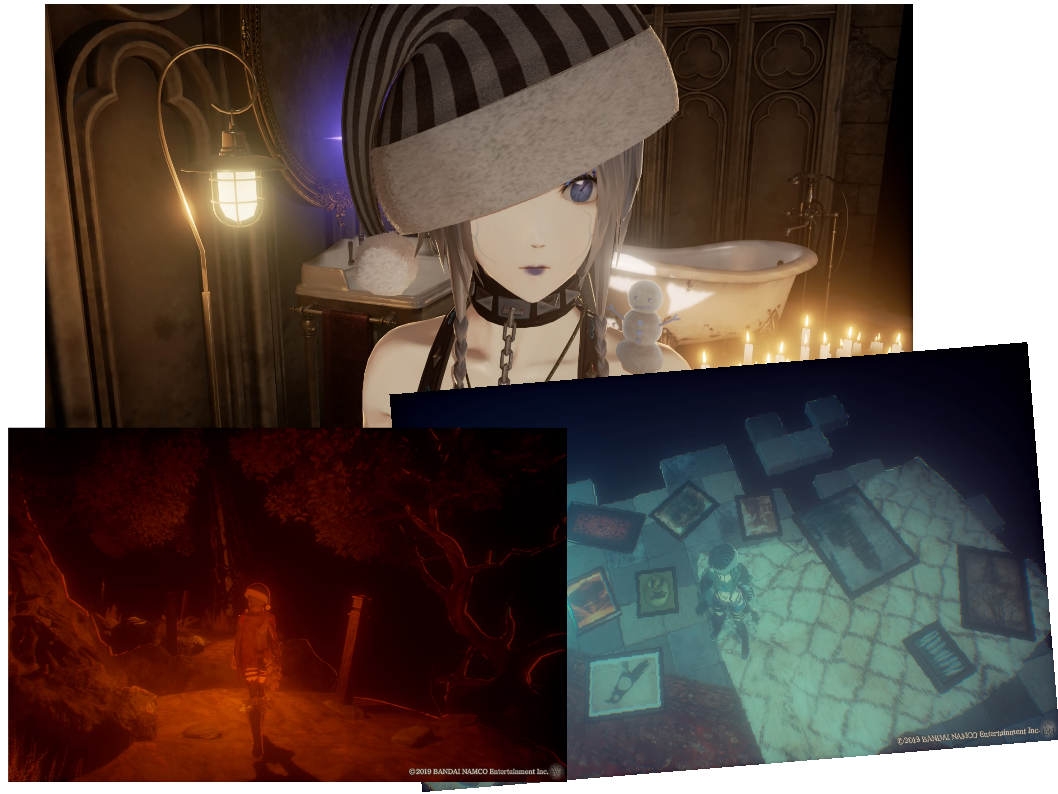
Second issue of “Characters, Diaries and Stories”, a collection of fan-fiction stories regarding peculiar RPG characters of my own invention written as tales, but based on the action of the actual character and together with screenshots (the previous story set in the world of Fallout 4 can be found HERE). I would like to promote in these articles the connection between character creation, fictional tales and free roaming games. In this issue I will tell the story of Elaiza, a soul able to travel between memories, dreams and nightmares. This character was created using the powerful character creator of Code Vein, an interesting dark Soul-like RPG released in September 2019. To tell Elaiza’s story, I will re-imagine the world of Code Vein as an irrational nightmare, which could be anyway not so far from the reality of the game.

The snow is a symbol of purity and perfection. While the ice is cold and distant. The snow brings happiness to the children. While the ice isolates entire families. Elaiza was out for an expedition in that snowy day. While the ice brought her to a tragic death.

Elaiza at the time was a young girl living with her tribe in a very unwelcoming and cold land. The ice and the snow were constantly shattering the environment, and the people were hiding in the ruins of a forgotten society in order to find ephemeral warm. Regardless of her young age, Elaiza was going in expeditions to collect burnable objects for the tribe, helping them to build bonfires to survive the cold night. It was during one of her expeditions that Elaiza embraced the cold death. She saw a rare medicinal plant on a cliff, something very important for her tribe, which could save many lives with its healing properties. At this point, the gears of a tragic machinery were already in motion. The wrong step, the unforgiving ice, and Elaiza was falling down the cliff. After her disappearance, the tribes searched for her everywhere, but when they finally found Elaiza, she was dead.

CODE VEIN_20200105034134

Destroyed for the grief and the sadness, for the tragic death of such a beautiful and lively flower, Elaiza’s parents decided to break one of the most ancient taboo of the tribe, contacting the exiled Dollmaker. The old man was a powerful shaman, able to infuse young deceased souls inside the artificial bodies that he created. He was exiled from the tribe, because his practices were considered forbidden magic, but for Elaiza’s parents that was the only chance to see their daughter again. The Dollmaker was able to help them. He created a beautiful doll based on the exact image of their deceased daughter. Chants, smoke, fire and ancient magic, the ingredients to alter the natural laws, to bind a deceased soul to an inanimate object. The mysteries of the universe are infinite, and the ritual worked. The doll started to move, and she was able to recognise her parents. But there was a grievous secret that nobody was aware of, that Elaiza didn’t die for the fall, but after hours of freezing in the cold. Unable to move, with her bones broken, Elaiza suffered the deadly embrace of coldness for hours, before to finally die. Even when she came back to life inside the artificial body of the doll, the coldness was always with her.

The doll was able to move and to talk, to experience and to feel. It was a huge success for the Dollmaker and Elaiza’s parents. But the problem of the cold was very serious. Whatever she was doing, that sense of coldness was always there. The fire was just a mite dancing entity. Hot steam was simply cool air. There was nothing warm enough to dispatch that horrible feeling. Day after day, the intense cold feeling was increasing, morphing the new artificial life of Elaiza into a hell of sufferance. One day, the cold was so strong that the glass eyes of her doll body cracked. The coldness got unbearable, and the only relief for the poor Elaiza was to sleep. Only by sleeping, she was feeling warm. She started to sleep more and more, in short but warm comas.

CODE VEIN_20200105034738

Elaiza’s dreams were not a void emptiness, as it could be expected from a doll, but weird and mystic travels full of life and surprises. Colorful roads lightened by sunrise, dreamlike fragmented landscapes made of floating islands, surreal cities, colossal statues and impossible geometries; Elaiza saw every possible and impossible thing inside the dreams. Her artificial life shifted toward the sleep, having the dream as the only way to experience a life without coldness. Because every new dream was like an unthinkable adventure, a place of mystery and surprises. Not everything was lively and colorful, and for every intense dawn and vivid forest, there was a dark pit, or a cold silence. Dreams and nightmares alternated between each others, like light and darkness, melting in complex and impossible landscapes. Elaiza’s travel in the dreamlike world became more challenging, sometime even dangerous. Pits opening from nowhere, mutable landscapes, sentience crystals and falling objects; many things were dangerous and unstable in this world.

code__vein

The time was passing, and the doll that once was Elaiza started to spend less and less time in the awake world. The cold and constant embrace of her daily pain couldn’t reach her while sleeping, and her soul was free to explore. Her powers of dream traveller increased, and with time Elaiza realised that she was able to enter inside the dreams of other people. She recognised other members of her tribe, while dreaming about a lost son, a hidden lover, or simply the challenges of the everyday life. The constant cold that was scourging her body while awake, inside the dreams, morphed, taking the shape of a small snowman. The persecution that was depriving Elaiza of a normal life, became in the dreams her closest friend, a small companion that was always standing on her shoulder.

code__vein2

But for Elaiza there was no rest even in the dream world, and the nightmares started to get more frequent. She went too deep into the dream world, and opened a door that brought her too close to the realm of nightmares. If before nightmares were only characterised by hazards or traps, now they were able to give birth to unthinkable monstrosities. One particular nightmare was also quite recurrent, a dangerous and tough land full of violence and deadly monsters. In this horrible nightmare, everybody was preying on each other. Evolved human beings called Revenants were feeding on the humans, using their powers to hunt them down. Nightmares here took the shape of entities called Lost, feral and aggressive creatures attacking whoever in their path. That place was a constant battlefield, and the blood of whoever was the victim was the trophy. Hunter or prey, there was no other way in this world. But the most horrible truth regarding this violent nightmare was that Elaiza got trapped there. No matter how much she tried, there was no way to come back to her cold reality, no way to wake up in her bed with her tribe.  After wandering through hundreds of mesmerising dreams, she was trapped in the worst of the nightmares.

Elaiza could only fight her way to survive in that nightmare. Lost and Revenants attacked from everywhere, horrible bloodthirsty monsters, but she was able to defeat them quite easily.  Somehow, she was draining power from the nightmare itself, absorbing the constituents of this violent reality. Her powers in the dream lands were growing more and more, giving not only the possibility to summon creatures, such as her loyal snowman, or strength, but also altering directly her body. Elaiza was able to modify herself using the essence of the nightmare itself, morphing her artificial body in grotesque creatures or deadly appendages.

CODE VEIN_20200107112410

Unable to wake up, trapped in a violent nightmare, with her body slowly morphing into a shapeless monster, Elaiza soul was at the edge of a breakdown. Then something happened. The Revenants realised of her powers, and they asked for her help against the Lost. The Revenants promised to stop their uncontrolled feeding on the other souls trapped in this nightmare, because they were also the victims of the Lost, which were sitting at the top of this nightmarish food chain. Elaiza found a purpose in this nightmare, but she was still unable to wake up. She continued to fight the Lost, defeating monsters after monster, while her body changed and her powers grew.
Will she ever be able to wake up from this nightmare? Or will her body corrupt into a nightmare before?

The gray machinery of the Inquisition behind the cute facade of Minoria [Review and Analysis]

When you check images of the new game from the creators of Momodora, Minoria, you see an interesting aesthetic full of cute characters, like a modern fairytale. But behind this delicate facade, Minoria touches really dark and delicate topics, from religion, to dogmas, the oppression of the weak ones and the violence against nature. The colorful aesthetic is hiding the gray moral patterns of Minoria’s plot and setting.

minoria

From the gameplay point of view, Minoria is a classic Metroidvania with a good RPG component. There are secrets to discover, different equipment and magics (called incenses), and also a bonus boss fight. The game is short for the genre (around 5 hours), but with 2 endings and also secret equipment unlocked when defeating a boss without getting damaged.

But the plot, the lore and the hidden layers built of small details are the most interesting side of Minoria. In the world of Minoria, an unforgiving Catholic Church is using the Inquisition to hunt for witches, powerful beings in contact with nature. If this is not dark enough, behind the fairytale facade of the art-style, the dark core of Minoria will slowly and subtly appear. First, it will be the dead bodies lying in the background, then it is the turn of lore books with really disturbing details.

20191004232628_1

It will soon be clear through notes and books that the silent protagonist was brainwashed to become an inquisitor. A weapon without a morality ready to kill whoever is judged by the Church. The Church is also a rotten and corrupted organization. For example, the Saints in this world are members of the clergy who now live isolated from the world, surrounded by extreme wealth and pleasures. If games like Blasphemous use the horror of religions and Inquisition in a very direct way, in Minoria everything is more subtle, the grayness is hidden in few lines of dialogue, or in the backgrounds. But the player will feel this sense of uneasiness. The lack of free will, and the absence of morality, are also translated into the gameplay. Somehow, the linearity of the game is the main responsible of creating those chains. While killing witches, you will soon realize that they are not that evil, but, anyway, you cannot do nothing other than killing them.

This is really evident while fighting a couple of specific bosses. When they will be at low health, they will stop fighting, dragging around the arena while cursing you. They are already defeated and deadly wounded, but you have no alternative than keep on fighting. There is no way to have pity for the boss. The main character cannot fight the orders of the Church, as well as the player cannot break the linearity of the game. But you would like to do that, to find a way to avoid these murders. The linearity of the game is making you question your morality. Why cannot stop? Why cannot avoid to kill this character? But you character is only a brainwashed gear of a bloodthirsty machinery, so you just keep on fighting. Only at the very end of the game, the player will have a real decision to do. But, even in this case, the choice is reverted, and a promised happy ending will bring to even more death; and also to a final boss fight against a hopeless and powerless character.

20190927011632_1

Under the main cathedral of the Order, a dark dungeon will reveal all the hidden torments caused by the Church. While fighting your way through the dungeon, you will meet skinny and traumatized prisoners who will only ask to kill them, such big is their pain. There is no reward for sparing or killing them, so also in this case the weight of your choices is meaningless, like if for the main character the life or death of another human being is totally irrelevant. This will cause a huge sense of uneasiness for the player, in a gorgeous and colorful world with fairytale-like characters, death will powerfully emerge from the background.

Also the concept of fighting against the nature will make you question your action. Some of the boss Battles are against primordial forces of nature, called Witch Deities, but is it truly necessary to destroy something so ancient? Also the main purpose of the game is to burn down a magic forest, which of course can open so many parallelism with the problems of our real world. But this is another story.

Behind all the colorful and the beauty of Minoria, a dark truth lies, a gray story where the linearity of the game will make you feel a brainwashed and blood-thirsty machine, without second thoughts for questions or pity. A deep story where nature and free will collide against dogmas and impositions.